Festival Hill at Round Top: The Complete Guide to Texas's Hidden Cultural Gem
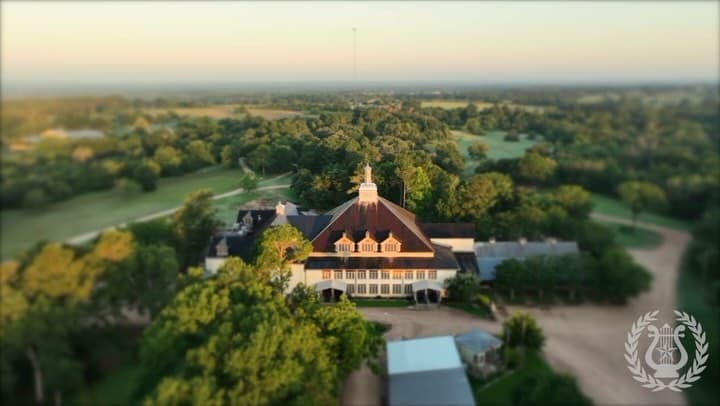
Most people come to Round Top for the antiques. They leave talking about something else entirely.
If you're planning to visit Round Top, Texas, you already know about the antique show. What you might not know is that one of the most extraordinary cultural destinations in all of Texas sits just steps from the main action — a world-class, 1,000-seat concert hall rising out of the central Texas pastureland, hand-built over decades by a devoted crew of craftsmen, and widely regarded as one of the finest acoustic spaces in the entire country.
Festival Hill in Round Top, Texas — the 200-acre campus of the International Festival Institute — is free, open year-round, and genuinely unlike anything else you'll find in the state. Whether you're wondering what to do in Round Top, Texas between vendor stops or looking for Round Top, Texas events during your stay, Festival Hill belongs at the top of your list.
One touring musician who stumbled upon it before a show put it simply: "That's probably one of the nicest venues I think I've ever played. You look at the Albert Hall and a few of these places — this is right on par with them."
He'd never heard of it either, until the day he arrived.
This is the complete guide to Festival Hill — how it came to be, what you'll find there, and why it deserves a permanent place on every Round Top itinerary.
A Kansas Farm Boy with a Dream
The story of the Round Top Festival begins not in Texas, but on a farm in Hutchinson, Kansas, with a boy named James Dick who had two things going for him early: an extraordinary gift for the piano, and a teacher back home who happened to have gone to school with a professor at the University of Texas.
That small-town connection led James to Austin, where renowned pianist Dalies Frantz immediately recognized his prodigious talent and took him on as a student. After graduating with honors, James earned a Fulbright Scholarship for two years of study in Europe, entered the international competition circuit — including the prestigious Tchaikovsky Competition — and launched a career as a touring concert pianist.
He was living the dream. But the dream kept nagging at him.
Lunch with Ima Hogg
The pivot point arrived in the form of a lunch invitation.
James's professor, Dalies Frantz, was a close friend of Ima Hogg — philanthropist, arts patron, and arguably the most influential woman in Texas cultural history. One day Frantz invited James to join him for lunch with Miss Ima at her Houston home, Bayou Bend.
Over that meal, she asked James what he planned to do with his summers now that he was back from Europe. He mentioned he'd been thinking about teaching. She asked if he'd ever heard of Round Top.
He hadn't.
He came up and looked around. He fell in love with the place.
Starting from Nothing
In 1971, James Dick founded the Round Top Festival Institute with 10 piano students and two concerts held in the old courthouse building in town. It was modest by any measure. But James had seen something in that rolling central Texas landscape — the same quality that had drawn Beethoven to the Vienna Woods, that had inspired the great European composers to do their best work in the countryside. A human-scale environment. Nature as muse.
In 1974, he purchased the land that would become Festival Hill. It was, by most accounts, a mess — piles of junk that had to be cleared every morning before work could begin. One volunteer remembered cleaning windows with a single-edged razor blade just to get a dormitory ready in time for the first summer festival. It was that kind of operation.
But something magical was already present. In the late 1970s, James performed on the porch of the first renovated building on campus alongside a young cellist named Yo-Yo Ma. A duet that, by all accounts, stopped everyone who heard it cold. The people who were there knew then: this place was something.
Building the Impossible
At some point, James proposed building a concert hall.
The board members who heard the idea — people who had watched this small, magical little treasure grow from borrowed buildings and folding chairs — couldn't imagine it. A 1,000-seat concert hall? Here? In a town of under 100 people?
But James had a vision, and he had a crew.
Construction began in the mid-1980s. There was no outside architect brought in to design the interior — just James, a structural engineer for the steel framework, and a devoted team of craftsmen, many of them drawing on the deep German and Czech woodworking traditions of the surrounding region. One master craftsman, a Czech man named Arnold Pacifica, mentored others on the crew who knew little about carpentry when they arrived. They learned. They stayed. They built.
The process took roughly 20 years.
For much of that time, the hall operated in stages — a concrete floor first, then park benches, then metal chairs, then plastic chairs from H-E-B, then finally the beautiful permanent upholstered seats that are there today. Little by little. Poco a poco — a musical term James adopted as the guiding philosophy of the entire project.
A Concert Hall Like No Other
Step inside Festival Hill's concert hall and the first thing that happens is your jaw drops.
The ceilings soar above you in an elaborate pyramid of handcrafted woodwork — pine, walnut, maple — assembled piece by piece over more than two decades. The octagonal ceiling medallions contain 94 individual pieces of wood each. The chandeliers — all four of them — were designed and built on-site because James couldn't find any he liked well enough to purchase. Celtic designs alternate with a pattern traced from a postcard of a stained-glass window in a cathedral in Lausanne, Switzerland, enlarged to two feet by two feet to fit the scale of the hall.
The columns on stage are the only elements they didn't build themselves — the saws on-site weren't long enough.
The aesthetic defies easy description. Visitors have compared it to Scandinavia, to Moorish architecture, to medieval Europe, to something out of Lord of the Rings. It's eclectic in the most joyful, unapologetic sense. And it works.
First-time visitors routinely guess the building dates to the turn of the last century — a testament to the quality and authenticity of the craftsmanship. The NBC Today Show called it "the crown jewel of Texas" — a nickname that stuck. Touring musicians who've played Carnegie Hall and London's Royal Albert Hall say the acoustics and craftsmanship stand alongside those legendary venues. All of it built by the people who worked there, in a town of fewer than 100.
What to See and Do at Festival Hill
Festival Hill isn't just a concert hall. It's a 200-acre campus that rewards exploration — and most of it is open to the public, free of charge, 365 days a year.
Walk the Grounds
The campus is beautifully landscaped with paths winding through mature trees, herb gardens, and open fields. It's a peaceful counterpoint to the busy show grounds, and many visitors treat it as a genuine nature walk — a place to reset your senses after the sensory overload of the antique market. Dogs are welcome on leash. Picnicking is encouraged. On a clear day, the rolling views of the surrounding countryside feel like something out of a European pastoral painting, which is exactly the effect James Dick was going for.
Keep an eye out for the sculpture garden on the plaza level, where you'll encounter one of the campus's most conversation-starting features: statues of Christian saints placed alongside figures of pagan gods. It's an intentional philosophical statement by the artist who curated the collection, designed to challenge visitors to think — to question dogma and spark conversation. It works. First-time visitors invariably stop, do a double-take, and start debating what it all means. That's the point.
Explore the Architecture
Festival Hill's buildings draw from an eclectic range of influences — European Gothic, Celtic, Moorish, Scandinavian — and much of the campus has been assembled over time from salvaged and relocated historic structures. Several buildings were physically moved from other locations and restored on-site. It gives the campus a layered, almost archaeological quality — as if it had been growing here for centuries rather than decades.
The architectural variety reflects both the founder's European inspirations and the remarkable resourcefulness of the craftsmen who built it all largely by hand, mostly from local materials. Take your time walking between the buildings and notice the details: the woodwork, the ironwork, the ways that different architectural traditions have been woven together into something cohesive and distinctly Festival Hill.
See the Concert Hall
If you get the chance to step inside, take it. Access to the concert hall interior depends on scheduled events and rehearsals — it's worth calling ahead or checking the festival's website if you're hoping to see inside. But when those doors are open, what you'll find is genuinely breathtaking: the soaring pyramid ceilings, the ornate medallion work, the warm glow of handcrafted wood in every direction. It's the kind of space that makes you stand still and look up.
Visit the David Guion Room
Inside the hall is a dedicated museum room honoring David Guion, a Texas composer best known for his arrangement of "Home on the Range." The institute holds his estate, including original concert posters from 1930s New York performances. It's a small but genuinely interesting piece of Texas musical history tucked inside an already remarkable building.
Catch a Performance
If your visit coincides with a festival performance or other event, don't pass it up. Attending a live performance in this hall is an experience that's hard to forget — the acoustics transform the music, and the visual grandeur of the space elevates everything that happens inside it.
The summer festival runs six weeks (June and July) and brings 80-100 young musicians from around the world on full scholarship for intensive orchestral training, culminating in weekly performances: chamber music at 1:30 PM and 3:30 PM, full orchestra at 7:30 PM on Saturdays.
Check the schedule at festivalhill.org before your trip.
Beyond Antique Week: Year-Round Programming
Here's what most people don't realize about Festival Hill: the programming extends far beyond the six-week summer festival. In fact, for many locals and returning visitors, the year-round calendar is the real draw.
The Summer Festival (June-July)
The flagship event is the International Festival-Institute summer program — six intensive weeks that bring 80-100 of the world's most talented young musicians to Round Top on full scholarship. They rehearse daily under world-class conductors and perform weekly: chamber music concerts at 1:30 PM and 3:30 PM, followed by full orchestra at 7:30 PM on Saturdays. The quality is staggering. These are musicians on the cusp of professional careers, performing in one of the finest acoustic spaces in America. The institute has alumni on six continents, playing in leading orchestras from Atlanta to Amsterdam.
The Concert Series (August-May)
From late summer through spring, Festival Hill hosts monthly concerts featuring a wide range of music — brass bands, mariachi, choral ensembles, solo piano recitals by James Dick himself. The patriotic concert is their biggest annual seller. These are intimate, high-quality performances in a venue that rivals anything you'd find in a major city, offered at a fraction of the price and none of the hassle.
Special Events
Beyond music, the campus hosts poetry forums, theater performances, choir and band concerts from local schools, and community gatherings throughout the year. It's not uncommon to stumble onto the campus and find a school group rehearsing in the concert hall or a poetry reading unfolding in one of the smaller buildings. Festival Hill is alive — it's a working cultural institution, not a museum.
The Man Behind It All
What began with 10 piano students and two concerts in a courthouse has become a globally recognized center for classical music education with more than 50 years of history. And the founder is still there.
James Dick — now in his 80s — still plays. Still teaches. Still walks the campus he willed into existence out of a cow pasture and an impossible dream. When asked how he feels about all of it, he doesn't reach for grand language. He just shakes his head a little and says: "I sometimes just wonder how on earth did it ever happen. I'm just overwhelmed by what all that put together can be done."
If you happen to be visiting during the Spring show (March) or Fall show (October), Festival Hill is one of the most serene escapes from the bustle of the antiques market — just minutes away, and worlds apart. And if you're looking for a reason to visit Round Top, Texas outside of show season entirely, the year-round concert calendar may be the best one there is.
Planning Your Visit
Here's everything you need to know to make the most of a trip to Festival Hill.
Address: 248 Jaster Road, Round Top, Texas — just outside the center of town. Easy to reach from the main antiques show corridors and a natural add-on to any Round Top itinerary.
Hours: The grounds are open 365 days a year, and admission to walk the campus is free. There's no gate fee, no ticket booth for the grounds — just walk in and explore.
Concert hall access: Depends on scheduled events and rehearsals. Call ahead or check festivalhill.org for the current calendar. If you're visiting during show season, the hall is often accessible during the day.
Tickets: Concert tickets are available at festivalhill.org or by phone. Prices are reasonable — this isn't big-city symphony pricing. If you time a weekend trip around one of their performances, you'll experience something truly unlike anything else in rural Texas.
Getting there: Festival Hill is about 90 minutes from either Austin or Houston. If you're already in Round Top for the antique show, it's a short drive or even a walk from the center of town. Parking on the campus is free and plentiful.
Tips for Getting the Most Out of Your Visit
Time it right. If you're visiting during the Spring or Fall antique show, the campus is a wonderful midday break from the market. Mornings on weekdays tend to be quietest for a peaceful walk.
Bring comfortable shoes. The campus is 200 acres, and the grounds are most enjoyable if you plan to wander rather than just park and peek. This is a place that reveals itself to people who take their time.
Check the event calendar. The festival schedule changes seasonally. Even outside summer, there are often performances, forums, and special events worth timing your visit around. You may be lucky enough to catch a concert during your stay.
Pair it with a meal. Round Top's restaurant scene has grown significantly. Use Round Top Finder to discover dining options near Festival Hill and plan your day around a visit.
Respect rehearsals. If the summer festival is in session, some areas may be closed or quiet hours observed. The staff is welcoming, but it's a working educational institution — be a gracious guest.
Bring the family. The campus is kid-friendly for walking and exploring, though young children should be supervised around the sculpture garden and buildings. The wide-open grounds and gardens are great for families who need a break from the market scene.
A Round Top Story for the Ages
Round Top has always been a place where people bring extraordinary things and set them down in unlikely soil. The antiques show draws treasures from across the world to a dot on the map in Fayette County. Festival Hill does the same thing with music, architecture, and human ambition.
Round Top is one of the smallest incorporated towns in Texas, with a population that hovers around 90 people. It has no business being home to a world-class concert hall. And yet here it is — rising out of the pastureland, waiting for anyone who walks through the gate.
Here's the thing about Festival Hill: almost everyone who discovers it says the same thing. "I've been coming to Round Top for years and somehow never made it here." Don't be that person.
Add it to your Round Top itinerary. Walk the grounds. Peek inside the concert hall if it's open. Check the event calendar. And if you catch a performance in that hand-built hall — surrounded by woodwork that took 20 years and a lifetime of vision to create — you'll understand why this place is one of the great Texas stories.
It's one of the top things to do in Round Top, Texas whether or not the antique show is running. And it's sitting right there, open to anyone.
Planning your Round Top trip? Round Top Finder helps you discover everything the area has to offer — vendors, venues, dining, lodging, and events all in one place. Explore more things to do in Round Top, check the latest show dates and schedule, or visit the Festival Hill venue page for hours, directions, and upcoming events.
Round Top Finder — Your guide to Round Top year-round. Vendors, dining, lodging, events, and more. Available on web, iOS, and Android.
You Might Also Like
Browse all venues on the interactive map or download the Round Top Finder app to plan your trip.
Full Guide
Round Top Life
Year-round community, real estate, and local life in Round Top.
Never Miss a Show
Get show dates, insider guides, and featured vendors delivered to your inbox. Monthly, never spammy.
Not ready to subscribe? Grab the free printable cheat sheet — no email required.