The Collector's Guide to Glass, Crystal & Mid-Century Finds at Round Top
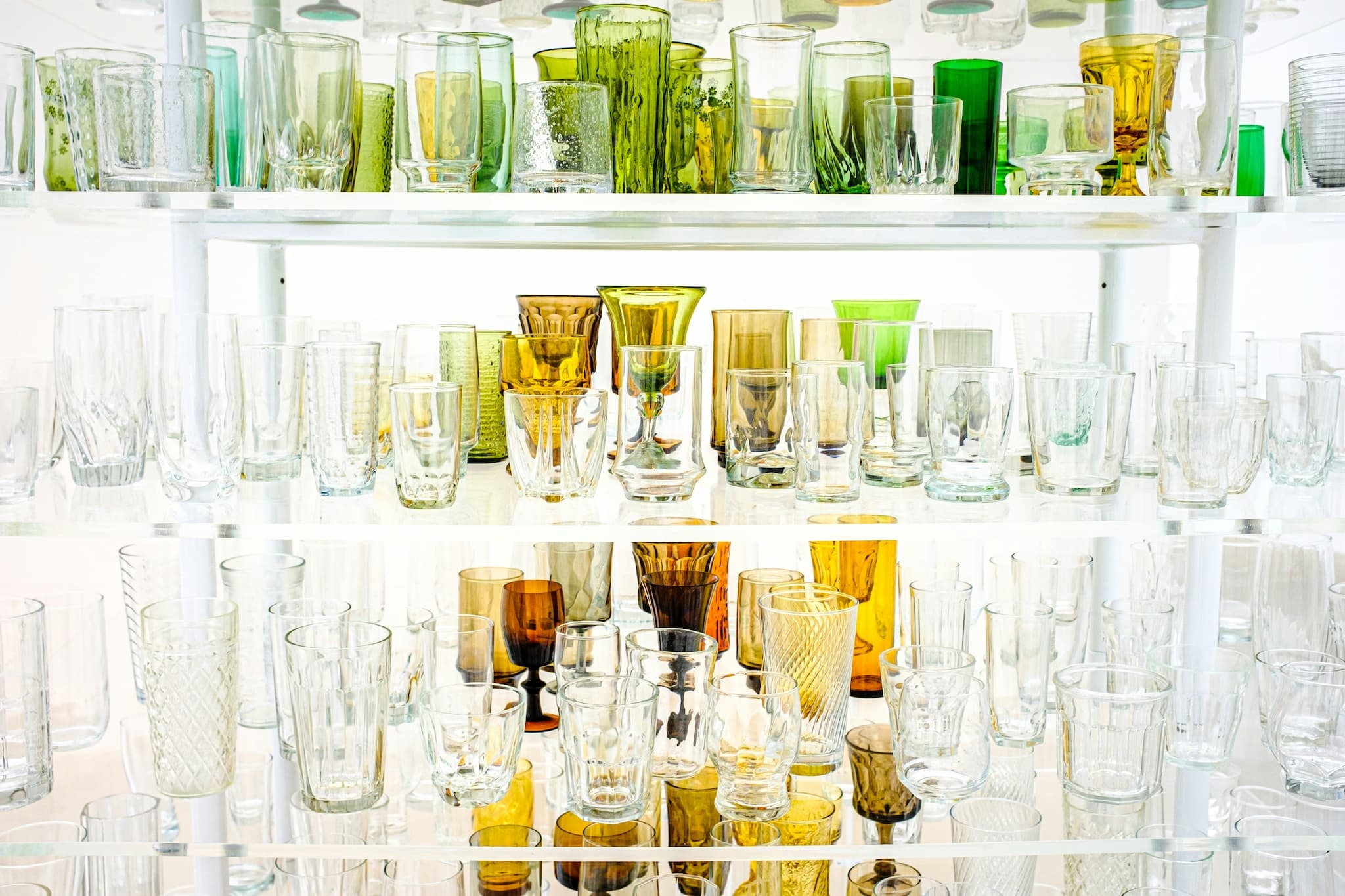
The American Brilliant period represents the golden age of cut glass production in the United States. From the Centennial Exposition in 1876 through World War I, American glasshouses produced some of the most elaborately cut crystal the world has ever seen — heavy, deeply incised pieces with geometric patterns that throw prismatic light across a room. At Round Top, this category draws dedicated collectors who plan their trips around it.
What to Look For
The major makers of the Brilliant period each have devoted followings. Dorflinger, Egginton, Libbey, Hawkes, Meriden, C.F. Monroe, and Strauss are the names that generate the most excitement when they appear on a dealer's table. You will find punch bowls, pitchers, vases, trays, cologne bottles, coffee pots, and lamps — the range of forms produced during this era was enormous.
The best pieces feature deep, precise cutting with sharp edges you can feel with your fingertip. Patterns like Harvard, Strawberry Diamond, and Russian were cut by hand on heavy lead crystal blanks, and the quality of execution varied enormously from one workshop to the next. A signed piece by a top maker in a rare pattern with no damage is the pinnacle of the category.
What to Expect to Pay
Prices for American Brilliant cut glass at Round Top range from around $800 for smaller unsigned pieces in common patterns to $25,000 or more for museum-quality examples with provenance. A signed Hawkes punch bowl in excellent condition might command $5,000 to $12,000 depending on pattern and size. Cologne bottles and smaller accessory pieces offer a more accessible entry point, often in the $800 to $2,500 range. Some pieces come with documented provenance from notable collections, which adds meaningfully to their value.
Tips for Buying
Check the base of every piece for a signature — many Brilliant period makers acid-etched their marks, and they can be easy to miss under tent lighting. Run your fingers along every edge and rim; even a tiny chip drops the value significantly. Hold the piece up and look through it — internal fractures and stress cracks become visible when light passes through. If a dealer tells you a piece is "as found" from an estate, ask which estate and whether they have any documentation.
Where to Find It
Big Red Barn is the primary destination for American Brilliant cut glass at Round Top. Specialist dealers in this category tend to set up there season after season, and serious collectors know to start their trip in that building. You will also find occasional pieces at Market Hill and Blue Hills, but Big Red Barn is where the depth of inventory lives.
Mid-Century Modern (1950s-1970s)
Mid-century modern has been one of the strongest categories at Round Top for years, and the supply shows no sign of thinning out. The aesthetic — clean lines, bold colors, a blend of natural wood and industrial materials like chrome and brass — translates perfectly to contemporary interiors, which keeps demand high among both collectors and designers.
What to Look For
The mid-century category at Round Top spans furniture, lighting, barware, and decorative accessories. On the furniture side, you will find Danish modern teak pieces, chrome-and-wood shelving units, and the kind of low-slung seating that defines the era. Lighting is a highlight: atomic starburst clocks, tiered lampshades, globe pendants, and sculptural table lamps turn up at multiple venues.
Barware is one of the most accessible entry points. George Briard cocktail glasses with their distinctive gold patterns, vintage decanters with brass stoppers, and complete cocktail sets in their original caddies are scattered across the show. Decorative accessories — everything from ceramic ashtrays to teak bowls to brass animal figurines — fill in the gaps.
Makers to watch for include George Briard (barware and serving pieces), Blenko (hand-blown glass pitchers and decanters), Viking Glass (the Epic line from 1956-1975 is particularly collectible), Bartlett Collins (painted glassware), and various Danish makers whose pieces sometimes still carry original import stickers.
What to Expect to Pay
Mid-century modern is one of the more affordable collecting categories at Round Top. A Blenko pitcher in a common color might run $45 to $150. A set of George Briard rocks glasses could be $28 to $60. Larger pieces — a Danish teak credenza, a brass arc floor lamp, a pair of matching lounge chairs — push into the $800 to $2,000 range. The sweet spot for most shoppers is the $28 to $200 range, where the volume of available inventory is enormous.
Tips for Buying
Check for original labels and stickers — a Blenko piece with its original foil sticker intact commands a premium. On chrome pieces, look carefully for pitting and flaking; re-chroming is expensive and not always worth the investment. For lamps, confirm that original shades are included — replacement shades for mid-century fixtures can be surprisingly hard to source. And for any upholstered furniture, check the foam; mid-century foam crumbles with age and reupholstering a chair costs more than most people expect.
Where to Find It
Y Station in Carmine is the standout venue for mid-century modern at Round Top. The concentration of dealers in this category there is remarkable, and the prices tend to be competitive. The Compound is another strong destination, particularly for lighting and decorative accessories. Excess II and various field venues along the corridor round out the options. If mid-century is your primary interest, plan to spend at least a full morning at Y Station.
Collectible Glass: A Category-by-Category Breakdown
Beyond the Brilliant period and mid-century modern, Round Top is a treasure trove for collectors of specific glass types. Here is what you will find and what to look for in each subcategory.
Fenton Art Glass
Fenton, the West Virginia glassmaker that operated from 1905 to 2011, has a passionate collector base, and Round Top delivers for them. You will find hand-painted pieces, carnival glass in iridescent finishes, and diamond optic patterns across multiple venues. Fenton's hand-painted work — often signed by the artist — ranges from delicate floral patterns on milk glass to bold designs on colored bases. Prices start around $25 for common pieces and climb to $500 or more for rare patterns, limited editions, or pieces by sought-after Fenton artists.
Murano and Venetian Glass
Italian art glass from the island of Murano turns up at Round Top as statement pieces — large bowls, sculptural figures, and decorative objects in vivid colors. Authentic Murano pieces are often signed or carry original labels from the furnace where they were made. Beware of reproductions; if a price seems too good for what is claimed to be Murano, it probably is. Expect to pay $150 to $5,000 depending on size, maker, and age.
Imperial Candlewick
Imperial Glass Company's Candlewick pattern — with its distinctive beaded edges in clear crystal — is one of the most recognized patterns in American glass collecting. The clear pieces are classic and widely available at Round Top, but the real finds are in rare variations: gold overlay, colors, and unusual forms. A gold overlay Candlewick piece in excellent condition is genuinely museum-worthy. Common clear pieces start around $15 to $30; rare variations can reach $500 or more.
Blenko Glass
Blenko's hand-blown glass from Milton, West Virginia is practically synonymous with mid-century American design. The tall, slender pitchers and carafes with their distinctive crackle finish are iconic. Colors matter enormously — tangerine, Persian blue, and amberina command the highest prices. A common Blenko decanter might be $45; a rare color in a desirable form can push past $400. Check the base for the Blenko sandblasted mark (used from 1958 onward) or the earlier foil stickers.
Viking Glass
Viking Glass Company operated from 1944 to 1986, and their Epic line (1956-1975) is the most collectible. The Bluenique color — a distinctive blue-green — is especially desirable among collectors. Viking also produced pieces in persimmon, avocado, and amber that have strong followings. Prices range from $20 for common pieces to $300 or more for rare Epic line forms in sought-after colors.
Depression Glass, Uranium Glass, and Milk Glass
These three categories are the accessible heart of glass collecting at Round Top. Depression glass from the 1920s-1940s — green, pink, amber, and clear in pressed patterns — is scattered across field venues and can be had for $5 to $50 per piece. Uranium glass (also called Vaseline glass) glows green under UV light and has developed a devoted following; bring a small blacklight flashlight and you will be amazed at what turns up in unsuspecting piles. Milk glass — opaque white pressed glass — is everywhere and starts at a few dollars per piece for common forms.
Cut-to-Clear Glass
Cut-to-clear is a European tradition, often from Poland or the Czech Republic (formerly Bohemia), where a layer of colored glass is cut through to reveal clear crystal beneath. The effect is dramatic — ruby red, cobalt blue, or emerald green patterns against sparkling clear glass. These pieces make excellent display items and range from $50 for small bowls to $1,000 or more for large vases and decanters in rare colors.
Bakelite Jewelry
Bakelite holds a special place at Round Top. As the first mass-produced synthetic plastic (patented in 1907), it was used to create jewelry in bold, saturated colors that have only grown more appealing with age. Bracelets, bangles, pins, and earrings in cherry red, butterscotch, marbled green, and deep black are the staples of the category.
What to Look For
Stackable bracelets are the most popular style — collectors build sets of complementary colors and wear them in groups of five or six. Carved Bakelite bangles with floral or geometric designs command higher prices than plain ones. Pins in figural designs (animals, flowers, bows) are another strong subcategory. Earrings in matching sets are less common and worth grabbing when you find them.
How to Authenticate
The classic test is simple: rub the piece vigorously with your thumb until it warms up, then smell it immediately. Genuine Bakelite produces a faint formaldehyde odor. This is not foolproof — some heavily lacquered pieces will not give off the smell — but it catches most fakes. Also check for cracks, especially at stress points on bangles. Bakelite becomes brittle with age, and a cracked bangle loses most of its value.
Where to Find It
Y Station consistently has a good selection of Bakelite jewelry. Field venues are also productive — Bakelite turns up in jewelry cases and mixed lots across the Warrenton area. Prices for common bangles start around $20 to $40; carved or rare-color pieces can reach $200 to $500. A truly exceptional carved Bakelite pin by a known designer can push past $1,000, but those are rare finds at any show.
Fine Crystal
Round Top draws dealers who specialize in high-end crystal from the major European and American houses. Waterford, Baccarat, and Lalique are the names that anchor this category, but there is depth beyond the biggest brands.
What to Look For
Waterford's Colleen pattern — with its deep vertical cuts — is the classic that everyone recognizes, and it turns up at Round Top regularly. Baccarat pieces, particularly stemware and decanters, attract buyers who know the brand's reputation for weight and clarity. Lalique's frosted crystal figures and vases occupy their own niche at the intersection of glass and sculpture.
Sterling-rimmed crystal is a subcategory worth learning about. Pieces with sterling silver rims, bases, or mounts by makers like Hamilton and Diesinger or Gorham combine the appeal of fine crystal with the collectibility of American silver. These hybrid pieces can be exceptional values — the silver content alone gives them a floor price, and the combination of materials makes them genuinely rare.
How to Tell Cut Crystal from Pressed Glass
This is one of the most important skills for any glass buyer at Round Top. Cut crystal is heavier than pressed glass of the same size. The cuts on genuine cut crystal have sharp, defined edges — run your finger across them and you will feel it. Pressed glass, which is molded rather than cut, has softer, rounder edges and a slightly different light refraction. When in doubt, hold the piece up to light: cut crystal throws sharp, defined rainbows; pressed glass produces softer, more diffuse light patterns.
What to Expect to Pay
Crystal prices at Round Top range from about $50 for individual Waterford stemware pieces to $12,500 or more for exceptional Baccarat or Lalique examples. Sterling-rimmed pieces occupy a wide range depending on the size of the piece and the quality of the silver work — $200 to $3,000 is typical. A complete Waterford decanter set in a sought-after pattern might be $400 to $1,200.
Where to Find It
Market Hill is the primary venue for high-end European crystal and sterling-rimmed pieces. Blue Hills carries European glass and French crystal across several dealer spaces. The Compound is another reliable source, particularly for French crystal, decorative glass, and lighting that incorporates crystal elements.
Venue Guide: Where to Find Each Category
Planning your route by category saves time and keeps you from walking past the best inventory. Here is a quick-reference breakdown.
| Category | Best Venues |
|---|---|
| American Brilliant Cut Glass | Big Red Barn |
| Mid-Century Modern | Y Station, The Compound, Excess II |
| Fenton, Collectible Glass | Multiple venues — field shows, Y Station, Blue Hills |
| Murano / Art Glass | Blue Hills, Market Hill |
| Bakelite Jewelry | Y Station, Warrenton field venues |
| Fine Crystal (Waterford, Baccarat) | Market Hill, Blue Hills |
| Depression / Uranium / Milk Glass | Warrenton field venues, Bar W Field |
| French Crystal & Decorative Glass | The Compound, Blue Hills |
| Sterling-Rimmed Crystal | Market Hill |
Use the Round Top Finder interactive map to plot your route before you arrive. You can filter by venue and save notes on where you want to stop.
Essential Tips for Glass and Crystal Collectors at Round Top
Buying glass and crystal at an outdoor antique show is different from buying in a shop or at auction. Here are the things that experienced collectors do every trip.
Bring a flashlight. Tent lighting flatters everything. A small, bright flashlight reveals chips, cracks, and repairs that are invisible under the ambient glow of a vendor's booth. This is the single most useful tool you can carry.
Hold pieces up to natural light. Step outside the tent or booth and examine the piece in daylight. Flaws that disappear under warm indoor lighting become obvious in full sun. Dealers expect this — it is not rude, it is smart.
Ask about provenance and maker marks. Good dealers know the history of their pieces and will share it freely. If a dealer cannot tell you anything about where a piece came from or who made it, that is information in itself.
Negotiate, especially late in the show. Prices at Round Top are negotiable by tradition. The first weekend of the show is when inventory is freshest and prices are firmest. By the second weekend, dealers are more motivated to make deals rather than pack unsold inventory back into their trucks. A respectful offer of 10-20% below the asking price is normal and expected.
Plan for shipping. If you are buying fragile pieces, do not assume you can carry them home safely in your car. Most dealers at the larger venues can wrap and ship purchases for you, or they can recommend local shipping services. Ask about shipping before you commit to a purchase, not after. Round Top Finder's vendor pages often note which dealers offer shipping.
Use the Round Top Finder app to keep track. When you are looking at dozens of pieces across multiple venues, it is easy to lose track of what you saw where. The Round Top Finder app lets you save vendor notes with photos so you can compare pieces before making a final decision.
Frequently Asked Questions
What is the best venue at Round Top for glass collectors?
It depends on what you collect. For American Brilliant cut glass and fine crystal, start at Big Red Barn and Market Hill. For mid-century glass, Blenko, Viking, and vintage barware, head to Y Station in Carmine. For affordable vintage glass like Depression glass and milk glass, the Warrenton field venues are your best bet.
How do I know if glass at Round Top is authentic?
Learn the basics of the category before you go. For Bakelite, use the rub-and-smell test. For Murano, look for signatures and original labels. For American Brilliant cut glass, check for acid-etched signatures on the base. For any piece, the weight, sharpness of cutting, and quality of the glass itself are your best guides. When in doubt, ask the dealer — reputable dealers welcome questions and are happy to educate buyers.
Are prices for glass and crystal negotiable at Round Top?
Yes. Negotiation is part of the Round Top culture. Offers of 10-20% below asking price are standard, and most dealers expect it. The second weekend of each show tends to see more flexibility on pricing as dealers prepare to pack up. Be respectful, be specific about what you are willing to pay, and be prepared to walk away — you might find the same piece at another venue for less.
Is it safe to buy glass at an outdoor antique show?
Absolutely, with basic precautions. Bring a flashlight to inspect pieces carefully. Hold glass up to natural light to check for damage. Ask about shipping options before you buy. And if you are carrying purchases with you, bring bubble wrap, newspaper, and sturdy boxes in your car. Many dealers sell pre-wrapped or will wrap your purchases at no charge.
When is the best time to shop for glass at Round Top?
Opening day and the first weekend offer the best selection — serious collectors and dealers arrive early to get first pick of fresh inventory. The second weekend offers better prices as dealers become more motivated to sell. If selection matters more than price, go early. If value matters more, go late.
What should I bring to Round Top if I am shopping for glass?
A small, bright flashlight is essential. A UV flashlight is great for spotting uranium glass. Comfortable shoes, sunscreen, and a hat are musts for outdoor venues. Bring bubble wrap and boxes in your car for safe transport. A portable phone charger keeps the Round Top Finder app running all day. And bring cash — some field vendors do not accept cards.
How much should I budget for glass collecting at Round Top?
You can have a fantastic time with $100 to $200 and come home with a dozen pieces of Depression glass, milk glass, or mid-century barware. A focused collector hunting for specific makers in specific categories should budget $500 to $2,000. Serious collectors pursuing American Brilliant cut glass or rare art glass should be prepared to spend $2,000 to $10,000 or more for a single exceptional piece.
Can dealers at Round Top ship fragile glass purchases?
Many dealers at the larger venues offer shipping services or can recommend local shippers who operate during show season. Ask about shipping costs and timelines before you finalize a purchase. For high-value pieces, some collectors arrange their own insured shipping through services that specialize in antiques. The Round Top Finder vendor directory can help you identify which dealers offer shipping.
Start Planning Your Glass-Collecting Trip
Round Top puts more glass, crystal, and mid-century finds in one place than any other antique show in the country. Whether you are building a Candlewick collection one piece at a time, hunting for a signed Hawkes punch bowl, or just hoping to stumble across a Blenko pitcher in the perfect shade of blue, the show delivers.
Use Round Top Finder to browse vendors, explore venues, and build your trip itinerary before you go. Filter by category, save your favorites, and use the interactive map to plan a route that hits every venue on your list. The next Round Top show is closer than you think — and the glass is not going to buy itself.
Full Guide
Round Top Antique Show
Complete guide to the world's largest antique fair — vendors, venues, dates, and tips.
Never Miss a Show
Get show dates, insider guides, and featured vendors delivered to your inbox. Monthly, never spammy.
Not ready to subscribe? Grab the free printable cheat sheet — no email required.