How to Date an Antique Quilt: Clues in the Fabric and the Stitching
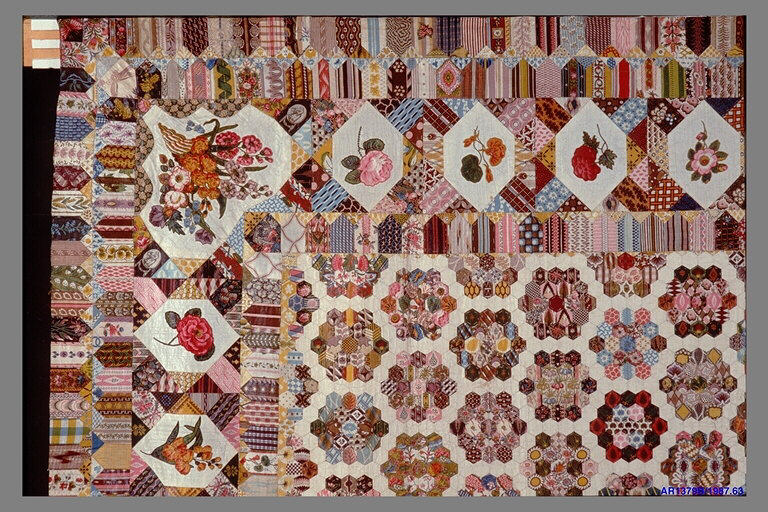
Dating an antique quilt is never exact. Quilters could always pull out older fabric from a scrap bag, and traditional formats continued across generations. But there are tells. Once you know where to look, you can usually place a quilt within a decade or two, and sometimes within a single year.
Here's the practical checklist to run through when you're standing in front of a quilt at a Round Top tent, or unfolding one from your grandmother's cedar chest at home.
The Stitch Count Test
This is the first thing an appraiser does, and it's the easiest thing you can do yourself. Make an inch with your fingers and count the stitches along the quilting line. Nine stitches or more per inch is the sign of a quality quilt.
There's a reason the phrase "a stitch in time saves nine" exists. It came from quilting. Nine stitches to an inch was the standard for good work.
Also look at consistency. Are the stitches uniform in length? In a quilting circle, women of similar age quilted together specifically so their stitches would match. A 25-year-old and a 105-year-old working the same quilt would produce wildly uneven stitching. Consistent stitches tell you one person, or a group of similar skill and age, sat with that quilt for a long time.
Dye Colors as a Timeline
Fabric dyes tell you a lot about when a quilt was made. This is one of the most reliable clues you have.
Before the Late 1880s: Vegetable Dyes
Vegetable dyes produced muted, earthy tones. Soft browns, quiet reds, dusty pinks, and grayed greens. If a quilt reads as a quieter palette overall, it's likely from before synthetic dyes took over.
One exception: turkey red. Turkey red was a remarkably stable dye that held its color. If you see a vivid, strong red on an older quilt that hasn't faded, it may be turkey red, and the quilt can still be early.
Late 1880s Onward: Synthetic Dyes
Synthetic dyes produced bright, vivid colors. But most of them weren't stable. They fade in characteristic ways. A red that was once bright now reads pinkish-tan. A green has shifted to teal, or past teal all the way to tan. When you see that specific fading pattern, you're likely looking at a quilt made from the late 1880s through the early 20th century.
Around 1916: A Muted Comeback
Germany supplied the chemicals for most synthetic dyes. When WWI cut off access, around 1916, American manufacturers reverted to natural materials. That produced muted earthy colors that were also unstable. A WWI-era quilt can look strangely like an early 19th-century one at first glance, but the pattern and the fabric widths will give it away.
After WWI: Aniline Dyes and Bright Colors
After the war, aniline dyes came in from Germany and you start seeing the very bright, saturated colors characteristic of 1920s and 1930s quilts. The cheerful, clear palette of a Grandma's Flower Garden or a Double Wedding Ring quilt comes straight from this dye shift.
Thread as a Clue
Mercerized cotton thread was introduced around 1840. It has a slight sheen and is very strong. If the quilting thread looks dull, short-staple, and matte, the quilt may be earlier. If it has that subtle luster and has held up well, you're likely in 1840 or later.
Specific Fabrics That Pin the Date
Polyester Double Knit: 1968 to 1979
This is the single most useful dating tool in the whole category. Polyester double knit was only manufactured for 11 years, from 1968 to 1979. If you see it, you know exactly when the quilt was made. The first four years of production were unstable and prone to gas fading and pilling. The better double knits came from the second half of that run.
Feed Sacks and Flour Sacks: 1930s to 1940s
Printed fabric bags used for animal feed and for commodity goods from Roosevelt's New Deal programs. Women saved the printed cotton and made clothing, curtains, and quilts from them. If you see small-scale prints in cheerful colors from this era, often with slight variations in the print alignment, you're probably looking at feed sack fabric.
Chintz with a Glaze
Glazed chintz, with its distinctive sheen from wax, heat, and pressure, is most commonly found on earlier quilts, generally pre-1900. It shows up in borders and central medallions on higher-end pieces.
Regional Tells
Where a quilt was made matters, especially in the South.
Appalachian Style
Scotch-Irish heritage. Repeat blocks, but each block looks a little different. Thick batting, sometimes with another whole quilt used inside as batting, or burlap bags, old curtains, even swimsuit fabric. Haphazard borders, or no borders at all. Quilted with Baptist or Methodist fans, concentric fan patterns running across the whole quilt without regard to the block design. Borders not matching is so Southern and so Appalachian. It's a regional characteristic, not a flaw.
Piedmont Swiss-German Style
More organized. Planned, symmetrical, with borders all the way around. Large circular or organized block designs. The Carolina Medallion, an applique pattern unique to the NC/SC Piedmont region, peaked from the 1870s through the 1890s.
Northern Quilts
Generally thinner than Southern quilts. A well-known example: a Log Cabin quilt from Pennsylvania in 1870 is noticeably thinner and more refined than its Appalachian cousins.
Why Precision Is Hard
A quilter in 1920 could use her mother's fabric scraps from 1880. A traditional pattern made in 1950 can look almost identical to one made in 1870. That's why appraisers look at everything together: stitch count, dye behavior, thread, specific fabrics, regional construction, and overall condition. Any one clue can mislead. Three or four together will get you close.
Next Step: Evaluating and Buying
Once you can roughly date a quilt, you're ready to decide what it's worth and whether to buy it. That's the next post in this series.
Browse more antique collecting guides and find textile dealers on the Round Top Finder map, or read the full Antiques Series at roundtopfinder.com.
Never Miss a Show
Get show dates, insider guides, and featured vendors delivered to your inbox. Monthly, never spammy.
Not ready to subscribe? Grab the free printable cheat sheet — no email required.