How to Date Your Flow Blue: Reading the Stamp and the Pattern
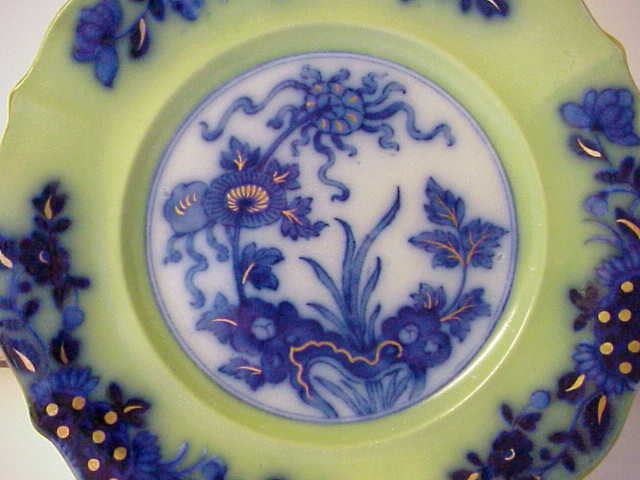
You're standing at a booth at Round Top. There's a stack of flow blue plates on the table. One is $45, one is $185, and you're trying to figure out if either is worth it.
The fastest way to answer that question is to learn to date the piece. Flow blue came out of two distinct production eras, and each has its own tells. Once you know the clues, you can flip a plate over and sort it into a time period in about ten seconds.
The Two Eras of Flow Blue
Flow blue was produced in Staffordshire, England from the 1820s through the 1860s, then went quiet for a couple of decades, then came back from the 1880s through the early 1900s. American potteries kept making it after that, into the 1940s.
Those early and later eras look different. That's your first big clue.
Early Era: 1820s to 1860s
Heavy on the blue. The cobalt often covers most of the plate, bleeding widely into the white, with designs that feel dense and Oriental in flavor. Early transferware flow blue leaned into temples, pagodas, and Asian landscapes. These pieces also tend to sit on a heavy ironstone base, so they feel substantial when you pick them up.
Middle Era: 1860 to 1885
The look softens. Less angular, more flowing. Floral and nature scenes take over, and you see more of the pattern itself rather than a wash of blue. This is the peak of Victorian romantic flow blue.
Late Era: 1885 to 1920
Semi-porcelain shows up, the blue covers less of the surface, and you start seeing added beading and embossing around the rims. The style feels lighter, almost fussier, with more white showing through.
The "England" Rule
Here's the single best dating trick you can use at a show. Flip the piece over and look at the stamp.
In the 1890s, US tax law required any import from England to be stamped "England" or "Made in England." That rule creates a simple divide.
- No country of origin on the stamp = likely pre-1890s. Probably an earlier piece.
- "England" on the stamp = post-1890s. Almost certainly from the later era.
- "Made in England" = even later, typically 20th century.
A classic example is the Formosa pattern. If the stamp just says "Formosa" with no country, you're likely looking at an early 1800s piece. The Oregon pattern from the 1820s and 1830s is similar: heavy cobalt coverage, Oriental design, no country of origin stamp.
Other Clues on the Stamp
Beyond the country mark, the stamp should also tell you the pattern name and the maker. Write both down, or better yet, snap a photo of the base with your phone. That's your key to looking the piece up later.
A good research move: search the pattern name on eBay and in flow blue guidebooks. A Google image search of the stamp itself can also identify the maker fast.
Gilding Is a Late-Era Tell
Gold trim, called gilding, is a tip-off that you're looking at a later pattern. Early flow blue didn't use it. If you see gold on the rim or mixed in with the blue, you're almost certainly in the 1885 to 1920 range.
The Four Pattern Categories
Flow blue patterns fall into four broad style categories. Knowing them helps you date and identify pieces fast.
- Romantic Scenery: Watau (1890-1910), Nonpareil (1891-1900), Italian Scenery (1890), Oriental (1890-1920)
- Oriental: Scinde (1840s), Amoy (1844), Cashmere (1850), Kabul (1847)
- Floral: Argyle (1896), Lonsdale (1910), Blue Danube (1900-1904), La Belle (early 1900s)
- Brushstroke: Cashmere (1850-1860), Aster and Grape (1840), Spinach and Hops, Tulip and Sprig (1845)
Oriental and brushstroke patterns tend to be earlier. Romantic scenery and elaborate florals lean later. That alone can put you in the right decade.
Putting It All Together at a Booth
Here's the quick workflow when you pick up a piece at Round Top:
- Flip it over. Is there a country of origin on the stamp? If no, it's likely pre-1890s.
- Read the pattern name and note the maker.
- Look at the blue coverage. Heavy and dense means earlier. Light with embossing means later.
- Check for gilding. Gold trim means later era.
- Feel the weight. A heavy ironstone base points to the early 1820s-1860s era.
Five seconds, and you've sorted the piece into a rough decade.
If you've been working through our ironstone series, a lot of this feels familiar. Flow blue and ironstone share a lot of the same Staffordshire history, and many of the same dating rules apply to both.
Next up in the series: what flow blue is actually worth, and how to spot a deal versus a markup. For more antique field guides, browse the Round Top Finder blog.
Never Miss a Show
Get show dates, insider guides, and featured vendors delivered to your inbox. Monthly, never spammy.
Not ready to subscribe? Grab the free printable cheat sheet — no email required.