Painted Furniture Pieces to Know at Round Top (and Why to Collect Them)
If you've walked Round Top and found yourself stopping in front of every painted cupboard, every worn blue chest, every little ladder back chair with a heart cutout, you already know the feeling. These pieces pull you in. They're practical, they're beautiful, and they've lived.
This is part two of our American painted furniture series. If you missed the first guide on the folk art tradition, start there. This one is the field guide. The specific pieces you'll see at the shows, what each one is good for, and why they're worth collecting.
Blanket Chests
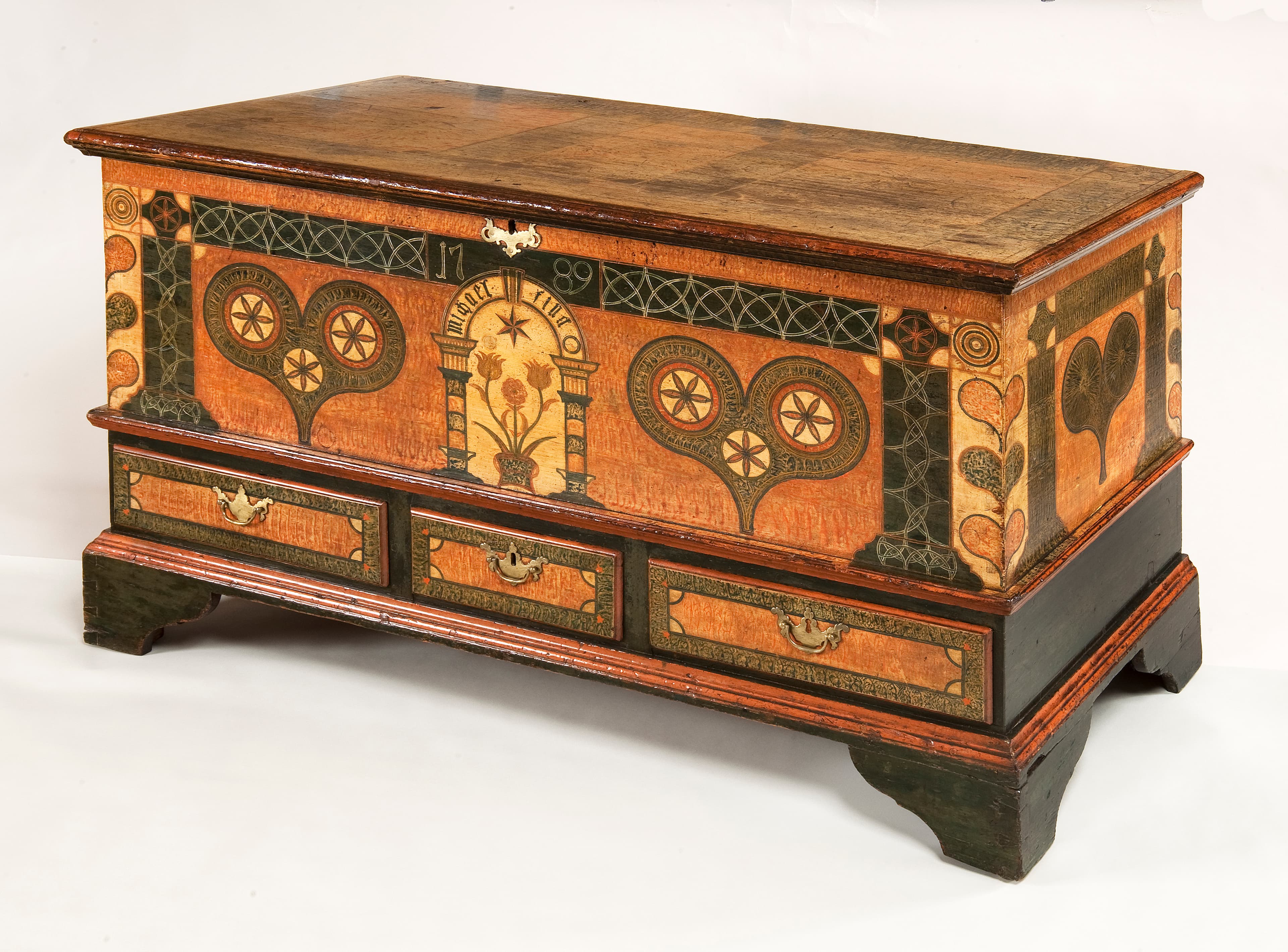
If you buy one painted piece, make it a blanket chest. It's the quintessential painted furniture object. Every Pennsylvania Dutch household had one. Every primitive home still should.
You'll see three finishes out there:
- Grain-painted chests, where the original maker faux-finished the wood to imitate a more expensive grain. Beautiful, and increasingly rare.
- Milk-painted chests, often in a worn blue, sage, barn red, or mustard. This is the look most collectors chase.
- Stripped or unfinished chests, where the paint has worn down to bare wood or was removed at some point.
Watch for the bootjack style, where the legs are cut so they look like you could stick your foot in and pull off a boot. It's a distinctive American primitive detail and a favorite among collectors.
How to use a blanket chest:
- At the foot of a bed, holding extra quilts and seasonal bedding
- As a coffee table with a tray on top
- In an entryway, as a bench and storage for boots and bags
- As a TV stand or console
- Stacked. Two or three chests of different sizes stacked together becomes a statement piece, and it's historically correct
Tavern Tables
If there's a second piece you should prioritize, it's a tavern table. One collector featured in a well-known primitive furniture guide bought her first tavern table at an estate sale for $75, decades ago, and it has been in every room of her house since. That's the case for this piece in a single sentence.
A tavern table is a simple four-legged table, usually with a lower stretcher shelf. The proportions are modest. The construction is honest. And it does everything:
- Kitchen or breakfast table
- Sofa table behind a couch
- End table next to a chair
- Desk in a small office nook
- Side table in an entryway
Prices at Round Top range widely. Simple worn examples can still be found in the low hundreds. Exceptional early pieces with original paint and documented provenance run considerably higher.
Sawbuck Tables
The sawbuck is close cousin to the tavern table but with X-form legs at each end, connected by a horizontal stringer through the middle of each X. The whole table can be assembled without a single nail or screw. It's a Pennsylvania Dutch favorite and it's sturdier and longer-lived than a trestle table.
If you want the primitive silhouette in a dining room and you love the geometry of those crossed legs, this is your piece.
Windsor Chairs
Windsors are the most recognizable American chair shape. Spindle backs. Saddle seats. Turned legs. Pennsylvania Dutch makers produced their own versions, and the form spread through colonial and early American homes.
Good news for Round Top shoppers. Windsors exist at every price point. In one well-known primitive furniture guide, the featured collector mentions picking them up at Salvation Army for $10 to $15 each. At the shows you'll pay more, but you can still find honest examples without breaking the bank.
A classic approach is to paint them black for a crisp primitive look. Gathered around a tavern table, a set of black Windsors gives you an instant, historically grounded kitchen.
Mix the chairs. Historically, American families didn't buy matching sets. They accumulated chairs over the years, and the mismatch is authentic.
Ladder Back Chairs
Ladder backs are the other Pennsylvania Dutch chair staple. Horizontal slats across the back instead of the vertical splat you'd see on a Queen Anne or Chippendale. Woven seats, which were more practical with the materials available and, honestly, more comfortable than a hard wooden seat.
Watch for the heart cutout or heart design on the top rail. It's a classic decorative detail and it's a charming touch on an otherwise plain country chair.
Banister back chairs are close relatives, with vertical turned spindles in the back. These also often feature a heart or pierced detail at the top.
Cupboards and Hutches
The cupboard is the single most versatile and most collected large piece in the primitive home. You'll see variations everywhere at Round Top:
- Step-back cupboards, where the upper section is set back from the lower
- Flat-front cupboards, where the whole piece is in one plane
- Open-top cupboards, with open shelves at the top for display
- Closed cupboards, with doors top and bottom
- Stacked cupboards, where a separate top and bottom were built to go together
Finishes run the full range. Original paint. Stained and waxed wood. Milk paint worn to a chalky shadow of itself. Grain painting on occasional pieces.
How to use a cupboard:
- Open the upper section and fill it with your collections. Ironstone pitchers. Flow blue plates. Redware pottery. Wooden bowls. Folded quilts and linens.
- Use the enclosed lower section for the things you don't want on display. Extra dishes, table linens, seasonal serving pieces.
- Put one in a dining room, a kitchen, a hallway, a bedroom. There's no room a good cupboard doesn't improve.
This is also where your ironstone, flow blue, and French pottery collections really start to sing. The painted cupboard is the frame. Your collected pieces are the picture.
What to Do with All This at Round Top
You don't need to buy everything at once. Start with a tavern table or a blanket chest, bring it home, live with it, and build from there. The next piece will tell you what it wants to be.
Next in this series, we'll get practical about identification. How to tell an antique painted piece from a reproduction on the floor of a show, when you have about three minutes to decide.
Browse painted furniture and primitive vendors on Round Top Finder before your next trip, and plan your route so you hit the right tents.
Never Miss a Show
Get show dates, insider guides, and featured vendors delivered to your inbox. Monthly, never spammy.
Not ready to subscribe? Grab the free printable cheat sheet — no email required.