The French Pottery Regions: How to Tell Them Apart at a Show
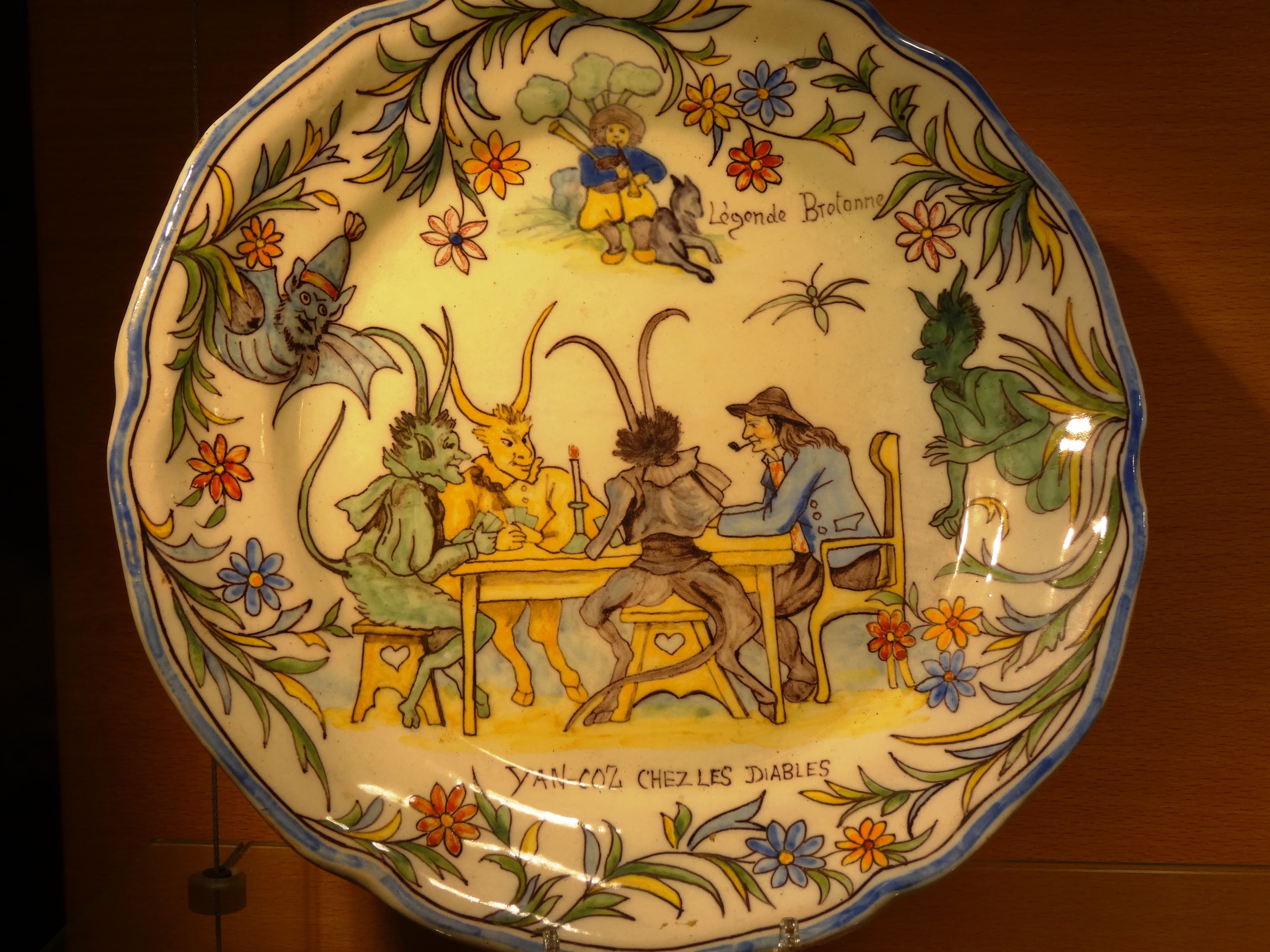
Once you know French faience exists, you start seeing it everywhere at Round Top. And once you see it everywhere, you start wondering: is this plate from the same place as that one? Why does one have dark cobalt backgrounds and another have delicate lacy borders?
The answer is that French faience was made in many different regions, and each region developed its own look. If you can recognize the four main ones, you can pick up a plate, turn it over, and have a pretty good guess at where and when it was made. That is the difference between buying pretty pottery and buying pottery you understand.
Nevers: The Dark Blue One
Nevers, in central France, was the first major faience center in the country. The Conrade family, Italian potters from Albissola, dominated early production starting in the late 16th century. If you see a piece of French faience with a rich, dark cobalt blue background and white-painted figures on top of it, you are probably looking at Nevers or something inspired by it. Collectors call it the Nevers blue.
The decoration often feels Oriental in flavor. Turbaned figures, shepherdesses, pastoral scenes. These are among the earliest and most collectible French faience pieces, and the finest examples sit in museum collections like the Frick.
At Round Top, a true 17th-century Nevers piece is rare. What you will more often find are 19th-century pieces made in the Nevers style, or later reproductions. Look for that distinctive dark blue ground with light figures floating on it.
Rouen: The Lacy Border One
Rouen, in Normandy, became a major faience center after 1644. By the first half of the 18th century, 18 different manufactories were operating in Rouen at the same time. Imagine the output.
Rouen's signature is the lambrequin border, an elaborate lacy edge that drapes around the rim of a plate or platter like stiff embroidered fabric. Early Rouen was blue monochrome, similar to Nevers and to Dutch delftware. Later Rouen got more elaborate, with polychrome work in blues, reds, yellows, and greens.
If you pick up a plate at a show and the border looks like intricate lace or fancy trim radiating out from the center, Rouen is your first guess.
Moustiers: The Southern One
Moustiers workshops opened around 1679 in Provence. The masterpieces date from about 1730. Moustiers has a lighter feeling than Nevers or Rouen. The palette tends toward softer blues and warm yellows. The decoration often features hunting scenes, mythological figures, and the kind of curling vegetal ornament you see on Provencal textiles.
Marseille, also in Provence, opened workshops around the same time as Moustiers. Strasbourg had its own regional style further north. Each smaller workshop had its own characteristic decoration and forms, but Moustiers is the one you are most likely to encounter labeled as such at a US antique show.
Quimper: The One You Probably Know
Quimper is the French pottery most American collectors have actually seen or owned. It comes from the town of Quimper in Brittany, in northwestern France, and it is tin-glazed earthenware just like the other regional faiences, but with a completely different visual personality.
Quimper is folk art. The decoration features Breton peasant figures in traditional costume, roosters, regional flowers, and simple borders. The palette is warm: yellow, blue, orange, green. It was made for everyday use, not aristocratic dining, and it is still produced today.
Marks to look for on the base: HB Quimper, Henriot Quimper, or just Quimper France. If the mark says France, the piece dates to 1891 or later (more on that rule in a moment). If it says Made in France, you are in the 20th century. Pre-1940 Quimper pieces are the most collectible.
How the Forms Changed Over Time
Regardless of region, the shapes of French faience tell you roughly when a piece was made.
- 16th and 17th century: display pieces, meant for a credenza or a garden orangery. Large, decorative, not usually eaten from.
- Late 17th to 18th century: full tableware. Soup tureens, platters, sauce boats, sugar castors, pitchers. This shift happened after Louis XIV's silver laws created the aristocratic frenzy for faience.
- 19th century onwards: everything. Plates for every day, cosmetic boxes, jugs, wall tiles. By this period production was industrial scale.
The Grand Feu vs Petit Feu Color Tell
One of the easiest dating clues is the color palette. Early pieces used the grand feu (high-fire) technique, which limited potters to five pigments that could survive the kiln: cobalt blue, manganese purple, antimony yellow, copper green, iron red.
In the mid-18th century, potters developed the petit feu (low-fire) technique, applying colors to an already-fired vessel. This opened up the palette to include pink and gold. If you see pink or gold on a piece of French faience, you are looking at something from roughly the mid-1700s or later. No exceptions.
The McKinley Tariff Dating Rule
The McKinley Tariff Act of 1891 required any import into the United States to be marked with its country of origin in English. So here is your quick check.
- Base marked France: made for export to the US, 1891 or later
- Base marked Made in France: 20th century
- No country of origin at all: potentially pre-1891, though very few faience pieces are signed at all, which is part of why attribution is so tricky
Next Up: Buying at the Show
Now that you can spot the regions and roughly date a piece, the next post in the series is the practical buyer's guide. What to look for on the base, what chips and crazes mean for value, and what you should actually expect to pay at Round Top. In the meantime, if you are planning your next visit, the Round Top Finder map will help you find the dealers who carry European and French pieces.
Never Miss a Show
Get show dates, insider guides, and featured vendors delivered to your inbox. Monthly, never spammy.
Not ready to subscribe? Grab the free printable cheat sheet — no email required.