The Show or The Hunt? How to Find Your Perfect Round Top Experience
The Show or The Hunt? How to Find Your Perfect Round Top Experience
Here is the single most useful thing anyone can tell you before your first trip to Round Top, Texas: it is not one antique show. It is two completely different shopping experiences happening along the same 11 miles of Highway 237, at the same time, attracting two very different kinds of shoppers.
One experience is curated, styled, and gallery-like — dealers who have traveled to France, Turkey, and across America to hand-select inventory displayed in climate-controlled tents and polished showrooms. The other is raw, unpredictable, and thrilling — open fields where you dig through piles, negotiate with a guy in a lawn chair, and occasionally uncover something extraordinary for the price of a nice dinner.
Both are legitimate. Both are loved by the people who come back for them, show after show. And most experienced Round Top shoppers enjoy both sides. But they attract different people for different reasons, reward different instincts, and require completely different strategies.
Understanding which experience you want — or at least which one to start with — is the difference between a trip that feels overwhelming and a trip that feels like it was made for you. Most first-timers don't know this distinction exists, and they spend their first day wandering between two worlds without fully landing in either one.
This guide fixes that.
"The Show" — The Curated Experience
Walk into Marburger Farm Antique Show during the first hours of a new show, and you'll understand immediately why interior designers fly in from New York and Los Angeles for this. Three hundred and fifty dealers spread across 43 acres of indoor, professionally lit exhibition space. Every booth is a styled vignette — a 19th-century French armoire positioned next to a crystal chandelier next to a stack of antique leather-bound books, the whole arrangement looking like it was lifted from the pages of Architectural Digest.
This is not a flea market. This is one of the premier antique exhibitions in the world that happens to take place in a field in rural Texas.
The Vibe
Gallery-like tents and permanent buildings with professional lighting, finished flooring, and intentional displays. Dealers here are not casual sellers cleaning out a barn. They are professionals who spend months between shows sourcing inventory from European estates, American collections, and international auctions. They know the provenance of their pieces. They can tell you the region and approximate decade of an Oushak rug by its weave pattern. They can explain why one Georgian sideboard is worth $3,000 and another is worth $30,000.
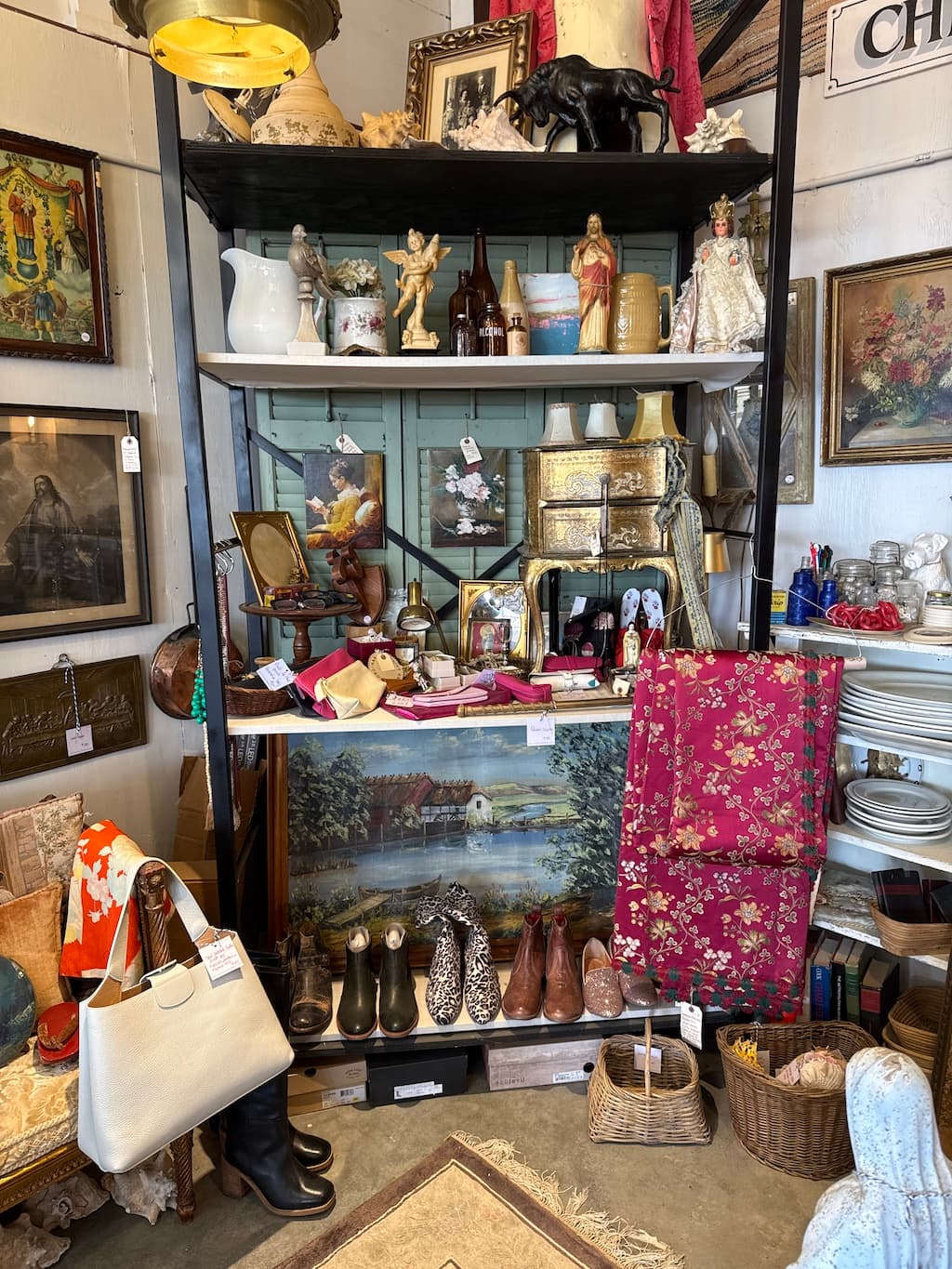
Everything is displayed with intention. Walk through The Compound and you'll see European architectural salvage — iron gates, carved stone mantels, zinc-topped tables — arranged in ways that help you visualize how these pieces would transform a room. Visit Market Hill and the curation feels even more editorial, each dealer's space feeling like a room in a magazine photo shoot. Bader Ranch, which Veranda Magazine named its top pick, takes this further still — the selection there represents some of the most refined antique dealing in the country.
Who Shops Here
Interior designers buying for clients with specific project needs. Serious antique collectors who know exactly what they're looking for and will examine hallmarks, joinery, and patina before making a decision. Home decorators looking for statement pieces that will anchor a room for decades. Repeat visitors who come every show because the inventory turns over completely — what was at Marburger in March will be gone by October, replaced by an entirely new collection.
Well-known designers and television personalities are spotted at these venues regularly. They come because Round Top's curated side offers dealer diversity and inventory volume that no single antique shop or design center in the country can match.
What You'll Find
Hand-knotted oriental rugs ranging from $2,000 to $30,000 and well beyond for museum-quality pieces. French and English antique furniture — armoires, farm tables, sideboards, secretaries, commodes. Fine art spanning three centuries. Sterling silver. Antique and estate jewelry. Architectural salvage from European estates — doors, mantels, hardware, iron work. Mid-century modern furniture and lighting. High-end vintage chandeliers and sconces. Antique textiles, tapestries, and grain sacks. Collections of antique botanical prints, maps, and engravings.
The inventory at venues like Marburger, The Compound, and The Arbors (which is particularly renowned for its rug dealers — 160 vendors, some specializing in hand-knotted rugs from Turkey, Persia, and the Caucasus) represents the kind of quality that in most cities would be found only in the most exclusive antique shops or at a major auction house.
Price Range
Expect to spend $500 to $50,000 or more per piece at the curated venues. The average purchase among serious buyers is probably in the $1,000 to $5,000 range. Credit cards are standard. Cash is welcome and occasionally nets you a small discount, but these dealers are running professional operations with card readers and invoicing capabilities. Shipping services are available on-site at most major curated venues — dealers are accustomed to selling pieces that need to be crated and shipped across the country.
The Venues
The curated side of Round Top centers on a handful of anchor venues:
Marburger Farm is the flagship — 350+ dealers on 43 acres, widely considered the single most important antique show venue in America. Opening day at Marburger sets the tone for the entire show season.
The Compound specializes in European antiques and architectural salvage. If you want a pair of 18th-century French doors or a carved limestone fireplace surround, this is where you go.
Market Hill may be the most design-curated venue on the corridor. Every dealer there feels hand-picked for an editorial eye.
Bader Ranch draws a particularly discerning crowd and has earned recognition from national shelter magazines as one of the best antique show venues in the country.
The Arbors is the rug destination — 160 vendors, many of whom specialize exclusively in hand-knotted rugs and textiles. If you're in the market for an Oushak, a Heriz, or a vintage kilim, this is where you'll find the deepest selection.
Blue Hills spreads across 26 acres with over 100,000 square feet of selling space. It bridges the curated and accessible sides of Round Top — more on that later.
Big Red Barn is where it all started. This is the original Round Top antique show venue, established in 1968, and it still operates with the kind of legacy quality you'd expect from the place that launched the whole phenomenon.
The Feeling
Walking through Marburger or The Compound during show week feels like visiting a world-class antique gallery that happens to exist under tents in the Texas countryside. It is aspirational. You might not be able to afford everything you see — most people can't — but you learn something in every booth. You develop your eye. You begin to understand the difference between a reproduction and an original, between something that is merely old and something that is genuinely significant.
Many people who come to Round Top for the curated experience describe it as educational as much as transactional. Even if you don't buy anything, you leave knowing more about furniture, design, and material culture than you did when you arrived.
"The Hunt" — The Treasure Hunt
Now drive south on Highway 237 toward the intersection with Highway 290. The landscape changes. Instead of polished tents with signage and landscaping, you start seeing open fields with hand-painted signs. Folding tables under pop-up canopies. Trucks backed up to the edge of a dirt lot, tailgates down, merchandise spilling out. A guy sitting in a camping chair next to a pile of architectural fragments, a stack of vintage signs, and a cardboard box full of old doorknobs.
Welcome to the hunt.
The Vibe
Nothing is styled. Nothing is curated in any traditional sense. The presentation is the absence of presentation — things are piled, stacked, leaned against fence posts, spread across tables, and sometimes just sitting in the grass. You have to look. You have to dig. You have to pick things up, turn them over, hold them up to the light, and occasionally ask "what IS this?" to a dealer who may or may not know the answer.
The thrill here is entirely in the finding. When you walk through a gallery-like tent at Marburger, you appreciate what's been selected for you. When you walk through a field venue in Warrenton, you are the selector. You are the curator. The good stuff isn't displayed on a pedestal — it's buried under three other things, and the person who sees it first gets it.
Who Shops Here
Pickers looking for things to resell — people who buy low in the fields and sell high online or in their own shops. Furniture flippers who see past the peeling paint to the solid-wood bones underneath. Budget-conscious decorators who would rather find a $75 farm table that needs some love than pay $2,500 for one that's been professionally restored. Groups of friends who drove down for a fun day out and want the flea-market experience — the laughing, the haggling, the "oh my God look at THIS" moments that make for great stories.
First-timers who want to understand what all the fuss is about often gravitate here first because it feels more accessible, more casual, more like something they've seen on television shows about finding hidden treasures.
These are people who love the story as much as the thing. "I found this in a field in Texas for $40" is a sentence that has launched a thousand Instagram posts and decorated a thousand living rooms.
What You'll Find
Everything from $5 vintage kitchen tools to $500 rustic farm tables. Old signs — tin, wood, enamel, hand-painted. Vintage clothing from every decade of the 20th century. Depression glass. Actual junk (real, honest junk — you'll learn to see past it). Garden furniture and planters. Reclaimed wood and industrial salvage. Quilts, blankets, and linens. Baskets by the dozen. Primitives and folk art. Architectural remnants — shutters, corbels, iron brackets, glass doorknobs. Vintage toys. Old tools. Things you didn't know existed until you saw them sitting on a folding table in the sun.
The inventory at field venues is wildly unpredictable. That is not a weakness. That IS the experience.
Price Range
Most purchases at field venues fall under $200. Many fall under $50. The range runs from $5 for a handful of vintage buttons to maybe $2,000 for a large piece of furniture, but the sweet spot — the zone where most of the action happens — is $20 to $300.
Cash is king on this side of the corridor. Many field vendors don't take credit cards. Some have Venmo or a card reader on their phone, but if you want to negotiate effectively — and you should — cash in hand moves the conversation. Negotiation is expected and enthusiastic. Some dealers have set prices. Others make it up based on some combination of what they paid, what they think it's worth, how late in the day it is, and (honestly) how much they like you. The standard opener is simple and polite: "Is that your best price?" Almost everyone will come down at least a little.
The Venues
The treasure-hunt side of Round Top centers on the Warrenton area, near the southern end of Highway 237 where it meets Highway 290:
Bar W Field is the largest outdoor venue — acres of open-air selling space with hundreds of vendors. This is ground zero for the hunt experience.
Zapp Hall mixes indoor and outdoor selling and attracts a blend of dealers, from professional pickers to folks selling off family collections.
Tree Park is a Warrenton fixture — a big loop of vendor spaces that you can walk through in an hour if you're moving fast, or three hours if you're actually looking at everything (which you should).
Dozens of smaller field venues and pop-ups line the highway in the Warrenton area. Some are named, some aren't. Some exist for one show and disappear. Part of the adventure is discovering new ones.
Further up the corridor, Excess 1 and Excess 2 sit in the middle stretch of Highway 237 and draw a mix of treasure hunters and deal-seekers. These venues are a picker's paradise — sprawling, diverse, and stocked with the kind of inventory that rewards patience and a sharp eye.
The Feeling
Walking through Bar W Field or a Warrenton tent feels like the world's greatest garage sale crossed with a county fair. It is chaotic. It is dusty (or muddy, depending on the weather — Round Top can deliver both in the same day). It is hot. It is exciting. It is unpredictable in a way that no curated experience can replicate.
You might leave with nothing. You might leave with the find of a lifetime. That uncertainty is the entire point. The hunt is the experience. The purchase, when it happens, is the proof.
The Overlap — Where Both Worlds Meet
The line between The Show and The Hunt is real, but it isn't perfectly clean. Round Top is 11 miles of nuance, and there are places where the two worlds bleed into each other in interesting ways.
Some curated venues have deal-priced items — a vendor at Marburger might have a basket of vintage French linen towels for $15 each tucked underneath a $4,000 armoire. Some field vendors have surprisingly high-end pieces — a picker in Warrenton might have pulled a genuine Heywood-Wakefield piece out of a barn and priced it at half what it would cost in a curated setting.
Blue Hills is probably the best "bridge" venue on the corridor — curated enough that the quality is reliable, but accessible enough in pricing and atmosphere that you don't need a designer's budget or vocabulary to feel comfortable shopping there. Excess and XS2 also attract both audiences, mixing professional dealers alongside casual sellers.
Many experienced Round Top shoppers do both in the same trip. A common pattern: curated shopping in the morning when you're fresh and your decision-making is sharp, then treasure hunting in the afternoon when you want the energy and spontaneity of the fields.
Some of the best finds at Round Top happen at the borders between these worlds — when a "Show" shopper wanders into a field and recognizes something the seller didn't know they had, or when a "Hunt" shopper stumbles into a curated tent and discovers that the piece they've been searching for actually exists and is worth the investment.
What Kind of Shopper Are You?
After a few shows, you start to recognize the patterns. Most people lean toward one side, even if they enjoy both. Here's how to figure out where you land.
You're probably a "Show" shopper if:
- You have a specific room or project in mind and you're shopping with a purpose
- You know what an Oushak rug is — or you want to learn
- You care about provenance, authenticity, and the story behind how a piece was made
- Your budget for a major piece is $1,000 or more and you think of furniture as a long-term investment
- You want air conditioning, good lighting, and displays that help you envision pieces in your own home
- You're an interior designer or you work with one
- You've described a furniture purchase as "an investment" at least once — and meant it
- You'd rather see 50 exceptional things than 5,000 random things
You're probably a "Hunt" shopper if:
- You'll know it when you see it — you don't have a list, you have an instinct
- Your favorite word at any market, anywhere, is "deal"
- You'd rather dig through a pile than browse a gallery because the pile might have something nobody else noticed
- You brought cash and a truck, or at least an SUV with the seats folded down
- You love the story behind a find as much as the find itself
- Your budget is flexible, but you physically cannot bring yourself to overpay for anything
- You've said "I can't believe I found this" at least once in your life — and it was one of your happiest moments
- You think of shopping as a sport, not an errand
You're probably an "Explorer" if:
- This is your first time at Round Top and you're trying to figure out what it even is
- You want to experience both the curated side and the treasure-hunt side before committing to either
- You don't know what you're looking for yet — and you're fine with that
- You have two or three days and you want variety, not specialization
- You're genuinely curious about why 100,000 people descend on a town of 90 residents three times a year
Most people who come to Round Top once as an Explorer come back as either a Show shopper or a Hunt shopper. Some come back as both. Nobody comes back as neither.
Venue Map by Experience Type
One of the most common questions first-timers ask is simply: where do I go? Here's a breakdown by experience type.
"The Show" Venues — Curated, Design-Forward
These are the indoor, styled, premium venues where you'll find the highest concentration of professional antique dealers and design-quality inventory:
- Marburger Farm — The flagship. 350+ dealers, 43 acres, the single most important antique show venue in America.
- The Compound — European antiques and architectural salvage. Limestone, iron, carved wood.
- Market Hill — The most editorially curated venue on the corridor. Every booth feels designed.
- Bader Ranch — Veranda Magazine's top pick. Refined, discerning, and worth the trip on its own.
- The Arbors — 160 vendors. The rug and textile destination. If you want hand-knotted rugs, start here.
- Big Red Barn — The original, since 1968. Legacy quality and historical significance.
- Henkel Hall — Intimate venue with a loyal following among designers.
"The Hunt" Venues — Treasure Hunt, Deal-Finding
These are the outdoor fields, picker-friendly venues, and casual markets where the thrill is in the discovery:
- Bar W Field — The largest outdoor venue. Acres of open-air selling. Ground zero for the hunt.
- Zapp Hall — Indoor-outdoor mix with a diverse vendor base. Good range of price points.
- Tree Park — Warrenton's big loop of vendor spaces. Walk it slowly.
- Northgate Field — Mid-corridor. Sprawling and diverse. Pickers love it.
- **Chicken Ranch ** — More of the same, just up the road. A treasure hunter's paradise.
- Tin Star, Sommerfield, Renck Field — Dozens of vendors wtih a huge variety or finds.
- Gypsies, Junk & Junque — The name tells you everything. Casual, fun, and full of surprises.
"The Bridge" Venues — A Bit of Both
These venues straddle the line — accessible enough for bargain hunters, curated enough for designers:
- Blue Hills — 26 acres, 100,000+ sq ft. Curated quality at a range of price points. The best starting point for Explorers.
- Excess 1 / Excess 2 — Listed above too, because they genuinely serve both audiences.
- The Venue — Mix of curated and casual vendors under one umbrella.
- Round Top Vintage Market — Year-round venue (open between shows) with a broad range.
Planning Your Trip by Type
Knowing which experience you want changes everything about how you plan your day. Here are the practical differences.
If You're a "Show" Shopper
Start at Marburger Farm. It opens early on the first day of each show, and the best selection goes to the earliest buyers. The opening hours of the opening day at Marburger are the most important shopping hours of the entire show season. Serious buyers plan their trips around this.
Consider early buyer or VIP access. Marburger and several other curated venues offer early admission, typically for $25 to $75 above the standard entry fee. For Show shoppers, this is not a splurge — it is a strategy. The best pieces sell in the first hours.
Wear nice but comfortable clothes. You're walking through gallery-like spaces with finished flooring and climate control. You don't need boots and jeans (though they're fine). You do need comfortable shoes — you'll walk miles without realizing it.
Bring credit cards. All major curated venues accept cards. Some dealers will give a small cash discount (usually 5-10%), but cards are the norm.
Allow 1 to 2 hours per major curated venue. Marburger alone can take three to four hours if you're thorough. Don't try to do five curated venues in one day — you'll burn out and start making bad decisions by venue three.
Eat at Royer's Round Top Cafe or one of the sit-down restaurants. You're making a day of it. A good lunch resets your energy and your eye. Royer's is an institution — the pies are famous — and there are several other excellent restaurants along the corridor during show weeks.
Ask about shipping. Most curated venues have shipping services available on-site. Don't let "how will I get this home" stop you from buying the right piece. Dealers ship large furniture across the country routinely.
If You're a "Hunt" Shopper
Start early at Bar W Field or the Warrenton venues. The best deals and the best selection happen in the first hours of the day. Pickers and resellers arrive at dawn. If you want first pick, you need to be there when the gates open.
Wear boots or shoes you don't mind getting dirty. Fields are dusty in dry weather and muddy after rain. Open-toed shoes are a mistake you'll make exactly once.
Bring cash. Lots of it. Many field vendors don't take credit cards, and even among those who do, cash gives you negotiating leverage. An ATM in a tent in Warrenton will charge you $5 per transaction. Come prepared.
Bring a truck, SUV, or trailer. If you find a farm table, a set of iron gates, or a stack of reclaimed barn wood — and you will be tempted — you need a way to get it home. This is not the kind of shopping you do with a sedan.
Move fast. At field venues, the good stuff gets picked early. Walk the entire venue once at speed to spot items, then double back for the things that stuck with you. If something stops you in your tracks, buy it now — it will not be there when you come back.
Negotiate everything — politely. The standard approach: pick up the item, look at it, look at the dealer, and ask "is that your best price?" or "what's the best you can do on this?" Smile when you ask. Most dealers expect this and have priced accordingly, building in room to come down 10-20%. Don't lowball aggressively — these are people who drove their inventory to a field in Texas, and they deserve respect. But do ask.
Eat at the food trucks. Warrenton has excellent food truck culture during show weeks — barbecue, tacos, kolaches, lemonade. It's faster, cheaper, and honestly part of the experience. Standing in a field eating brisket out of a paper tray while eyeing a pile of vintage signs across the lane is one of the great pleasures of the hunt.
If You're an Explorer (First-Timer)
Day 1, morning: Start with a curated venue. Marburger Farm or Blue Hills are the best choices. The styling and organization at curated venues help you understand what you're looking at. You'll start to recognize styles, periods, and quality levels. Think of it as calibrating your eye before you step into the chaos.
Day 1, afternoon: Venture to a field venue. Bar W Field or the Excess venues are good first stops on the hunt side. Feel the contrast. Notice how different the energy is. Notice what catches your eye when nothing is styled for you — that instinct tells you a lot about what kind of shopper you really are.
Day 2: Go back to whichever side resonated more, and go deep. If the curated venues spoke to you, spend your second day at The Compound, Market Hill, and The Arbors. If the fields called your name, head to Warrenton and spend the day picking through every venue you can find.
Don't try to see everything. There are 47 venues spread across 11 miles. Seeing all of them in two days is physically impossible and attempting it will leave you exhausted and overwhelmed. Pick six to eight venues and give yourself time to actually enjoy them. Rushing through Round Top defeats the purpose entirely.
Take notes or photos of booth numbers. At large venues like Marburger, you'll want to remember where you saw something so you can find it again. Dealers are usually in numbered booths. Take a photo of the booth number and the item. This saves enormous amounts of time and frustration.
Why Both Sides Matter
Round Top wouldn't be Round Top without both experiences existing side by side.
The curated dealers set the reputation. They're the reason national magazines write about Round Top, the reason designers book flights here, the reason the show has earned its standing as the largest and most significant antique fair in the world. The quality and professionalism at venues like Marburger, The Compound, and Bader Ranch establish Round Top as something more than a flea market.
The fields set the energy. They're the reason 100,000 people come — not just designers and collectors, but families, friend groups, couples, road-trippers, and curious first-timers who heard about "that big antique thing in Texas" and decided to see it for themselves. The fields make Round Top democratic. You don't need a budget or a vocabulary to have the time of your life at Bar W Field.
Many of today's best curated dealers started as field pickers. They learned their eye in the Warrenton fields, developed their taste by handling thousands of objects, and eventually built the kind of expertise that now fills a styled booth at Marburger. The two sides of Round Top aren't in competition — they're an ecosystem.
The corridor works because it has something for everyone. A designer and a picker can drive down Highway 237 together, split up at the first intersection, spend the entire day having completely different experiences, meet up for dinner, and both say it was the best day they've had in months.
That's what makes Round Top unlike any other antique show in the world. Not just the scale. Not just the selection. The fact that it contains two entirely different experiences, each one world-class in its own right, coexisting along 11 miles of Texas highway.
Whether you're a Show shopper, a Hunt shopper, or an Explorer still figuring out which side calls to you — Round Top Finder covers all 47 venues with maps, vendor directories, show dates, and planning tools designed to help you find your experience, whatever that looks like.
Full Guide
Round Top Antique Show
Complete guide to the world's largest antique fair — vendors, venues, dates, and tips.
Never Miss a Show
Get show dates, insider guides, and featured vendors delivered to your inbox. Monthly, never spammy.
Not ready to subscribe? Grab the free printable cheat sheet — no email required.