What Is an Antique Quilt? A Guide to the Types You'll Find at Round Top
There's a reason that so many people have a quilt story. A quilt expert named Dr. Carolyn Misloomi once said that textiles touch us on a human and almost spiritual level, because they are the first things we touch when we're born and the last things that enshroud us when we die. That's the whole category in one sentence. No wonder you pause at the quilt rack on the way out of a tent at Round Top, even when you didn't mean to buy another one.
Before you walk the show, it helps to know what you're actually looking at. Here's a warm, practical guide to the main types of antique quilts you'll find, and what makes each one special.
What Counts as a Quilt
Technically, a quilt is three layers. The backing, the batting (the interior insulation), and the front, which is the decorative component. Those three layers are held together by the quilting itself, which is the stitching that brings all three pieces together. That stitching is doing structural and decorative work at the same time.
Sometimes you'll see a quilt top for sale with no backing and no batting. It's not a failure, and it's not worthless. Some were never finished. Some were made intentionally as summer bed covers, lighter weight for hot months. Just know what you're buying.
The Types You'll See on the Fields
Whole Cloth Quilts
Whole cloth quilts use the same fabric throughout the top. In the 18th century, looms weren't wide enough for a full bed cover, so pieces of the same fabric were sewn together. All the decoration comes from the quilting pattern itself, the stitched design traveling across an unbroken field of cloth. This was a sign of affluence when textiles were expensive. If you find one, you're holding something early and rare.
Patchwork Quilts
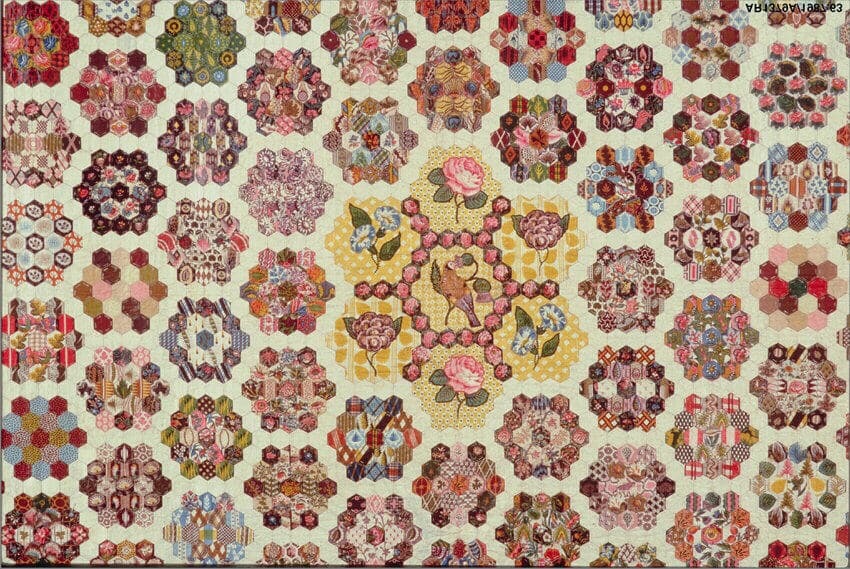
This is the iconic American quilt. Pieced together from many different fabrics, the patchwork quilt became widespread in the mid-19th century as printed fabrics became more affordable. Patterns began to develop names and spread across communities. Double Monkey Wrench. Shoefly. Wheel of Fortune. Carolina Lily. One pattern often carries two or three different names depending on who was making it and where.
White Work and Trapunto
All white cotton. Every bit of decoration comes from the quilting. The best white work quilts include trapunto, sometimes called stuffed work, where the quilter inserts stuffing from behind specific areas to create dimensionality. Sunflowers, cornucopias, and other motifs literally pop out from the surface. Thousands of tiny, evenly spaced stitches. This is virtuosic craftsmanship, and when you find a good one at Round Top, you'll understand why it's in a different price tier.
Crazy Quilts
Late Victorian. Dark velvets, satins, and silks cut into tiny irregular pieces and stitched together with lots of embroidery, sometimes thick yarn work called turkey work. Crazy quilts declined in the early 20th century as cotton was considered more healthful than velvet or satin, which attracted dust and insects. They're moody and ornate and unmistakable.
Log Cabin Quilts
Strips of fabric arranged around a center square, block after block. One of the most enduring traditional patterns in American quilting. A log cabin quilt is like a good piece of ironstone: simple, structurally beautiful, and it works with almost any room.
Show Quilts vs. Everyday Quilts
A lot of the antique quilts that survived in excellent condition are show quilts, the ones made specifically for display and for quilting competitions at 19th-century agricultural fairs. They were never slept under. They were made to be seen. In the 18th century, the master bedroom was often in a parlor or public space of the house, because expensive textiles needed to be visible to visitors. Quilts were an announcement.
Everyday quilts, the ones that got loved and used, are the ones with the softer stories. They're also the ones that show wear. Both are valid. Which one you want depends on what you're collecting for.
The Recycling Tradition
Dresses. Children's clothes. A scrap of a first communion dress tucked into a border. This is where quilts get emotionally powerful. Pieces of a child's dress could follow them through life in a quilt, and later show up in a quilt their grandchild slept under. When a dealer tells you a quilt has seven different family members listed in the credit line because it was passed down generation after generation, that's not a sales pitch. That's the category.
Chintz, the Fabric That Changed American Quilting
Chintz originated in India. The word is Hindi and means embellished cotton. The British became obsessed with replicating it, and eventually so did everyone else. Chintz has a distinctive sheen or glaze, created with wax, heat, and pressure. Before artificial lighting, that luminosity would have given interiors a beautiful atmospheric quality, almost glowing in candlelight. You'll see chintz borders and panels on higher-end antique quilts, and once you've noticed the sheen you won't miss it again.
Start Where You Are
If you have your grandmother's quilt in a closet and don't know what it is, take it out. Lay it flat. Look at the three layers, look at the pattern, notice the fabrics. You may already own one of the types described above, and you'll know more about your own family's history by the time you finish reading the next post in this series.
Next up: how to date an antique quilt using the stitches, the dyes, and the thread. Because once you know when a quilt was made, every other question about it gets easier to answer.
Explore more collecting guides in our Antiques Series on Round Top Finder, and use the show map to find vendors carrying antique textiles this season.
Never Miss a Show
Get show dates, insider guides, and featured vendors delivered to your inbox. Monthly, never spammy.
Not ready to subscribe? Grab the free printable cheat sheet — no email required.