What Is Flow Blue China Worth? A Buyer's Value Guide
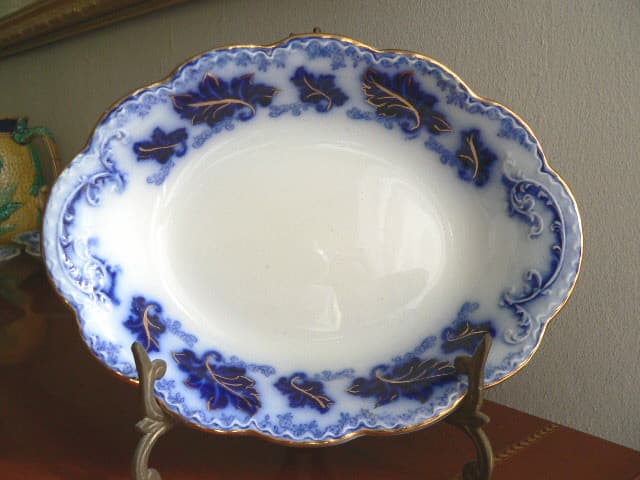
Flow blue is one of those antiques where the same pattern can show up at $35 in one booth and $500 in another. Sometimes that gap makes sense. Sometimes it doesn't.
If you're shopping Round Top and trying to decide whether a piece is a steal or a stretch, here's what actually drives the price.
The Range You Should Expect
Flow blue runs across a huge price spectrum. At the low end, common pieces in rough shape can sell for as little as $5 at an estate sale or yard sale. On the high end, rare patterns in excellent condition have sold for $800 or more.
Most of what you'll see at a show falls in the $35 to $500 range, depending on the condition, the pattern, the type of piece, the age, and what the market is paying that week.
What Actually Drives the Price
1. Condition Is Everything
This one matters more than age, maker, or pattern. A piece with no chips, no cracks, and no repairs is worth dramatically more than the same piece with any damage.
Before you pay anything, run a fingernail around the rim. Hold the piece up to the light. Look for hairline cracks on the base. A chipped tureen lid can take 50 to 70 percent off the value.
2. Rarity of the Pattern
Some flow blue patterns show up everywhere. Others are scarce. La Belle turns up often. Some of the early Oriental patterns like Scinde or Amoy are much harder to find. If you recognize a rare pattern name on the stamp, that's an instant value signal.
3. The Type of Piece
This is the one that surprises people. A sugar bowl with its lid intact is worth more than a dinner plate, and it's not because the sugar bowl is fancier. It's because the sugar bowl has more parts. Lids, handles, finials, and spouts break. The more pieces a piece has, the rarer it is to find it whole a century later.
Covered tureens, sugar bowls with lids, teapots, and pitcher-and-basin sets are all worth more than flatware for this exact reason. Plates and saucers are common. Intact covered serving pieces are not.
4. Age
Early flow blue from the 1820s through the 1860s, with heavy cobalt coverage and no country-of-origin stamp, tends to command higher prices than late-era pieces from 1885 to 1920. If you need a refresher on dating, see our earlier post on reading the stamp.
Real Sales at the Top of the Market
To calibrate what the high end looks like, a few notable flow blue sales:
- Covered tureen: sold for $600 plus
- Pitcher and basin set: sold for $650 plus
- Soup tureen with ladle: sold for $775 plus
Notice the pattern. Every top sale is a multi-part piece in complete, undamaged condition. That's not a coincidence.
Watch Out for 1980s Reproductions
Flow blue reproductions from the 1980s exist, and they can fool newer collectors. They look right at a glance, but they hold very little value compared to antique originals.
Tells on reproductions:
- The weight is often lighter than genuine early pieces with ironstone bases
- The blue can look flatter and less dimensional
- Stamps may say "made in" with a country other than England, or have a modern-looking logo
- Price too low for what the pattern usually goes for
Reproductions are perfectly fine for everyday home use. You can stack them, use them on a table, enjoy them daily. Just don't pay antique prices for them.
When NOT to Buy
Skip the piece if:
- There's a chip or crack and the seller hasn't priced it down accordingly
- The piece has been repaired or glued (check the light through the porcelain)
- The seller can't tell you the pattern name and is pricing it like a rare piece
- The price doesn't reflect the condition
Where the Deals Live
Round Top is one of the best places in the country to shop flow blue, because so many dealers bring it and you can comparison-shop across dozens of booths in a single afternoon. Use the show map to hit multiple venues in a day.
Estate sales are hit-or-miss but can produce incredible finds. Thrift stores are long shots, but the pieces that slip through at thrift prices make up for the misses.
A practical tip: snap a photo of every stamp you find interesting. You can look up pattern values on eBay that night and come back to the booth the next morning with confidence, or pass with confidence.
The Memory Test
One last thing. Flow blue collectors often talk about "memories over money." If a piece makes you happy every time you look at it, if it reminds you of your grandmother's table or the day you spotted it at Round Top, that matters more than what it would fetch at auction. A $45 plate you love is a better buy than a $400 tureen that just sits in a cabinet.
Next up: how to actually start a flow blue collection, from what to buy first to how to care for it. In the meantime, explore more antique guides on the Round Top Finder blog.
Full Guide
Round Top Antique Show
Complete guide to the world's largest antique fair — vendors, venues, dates, and tips.
Never Miss a Show
Get show dates, insider guides, and featured vendors delivered to your inbox. Monthly, never spammy.
Not ready to subscribe? Grab the free printable cheat sheet — no email required.