What to Look For When Buying French Pottery at an Antique Show
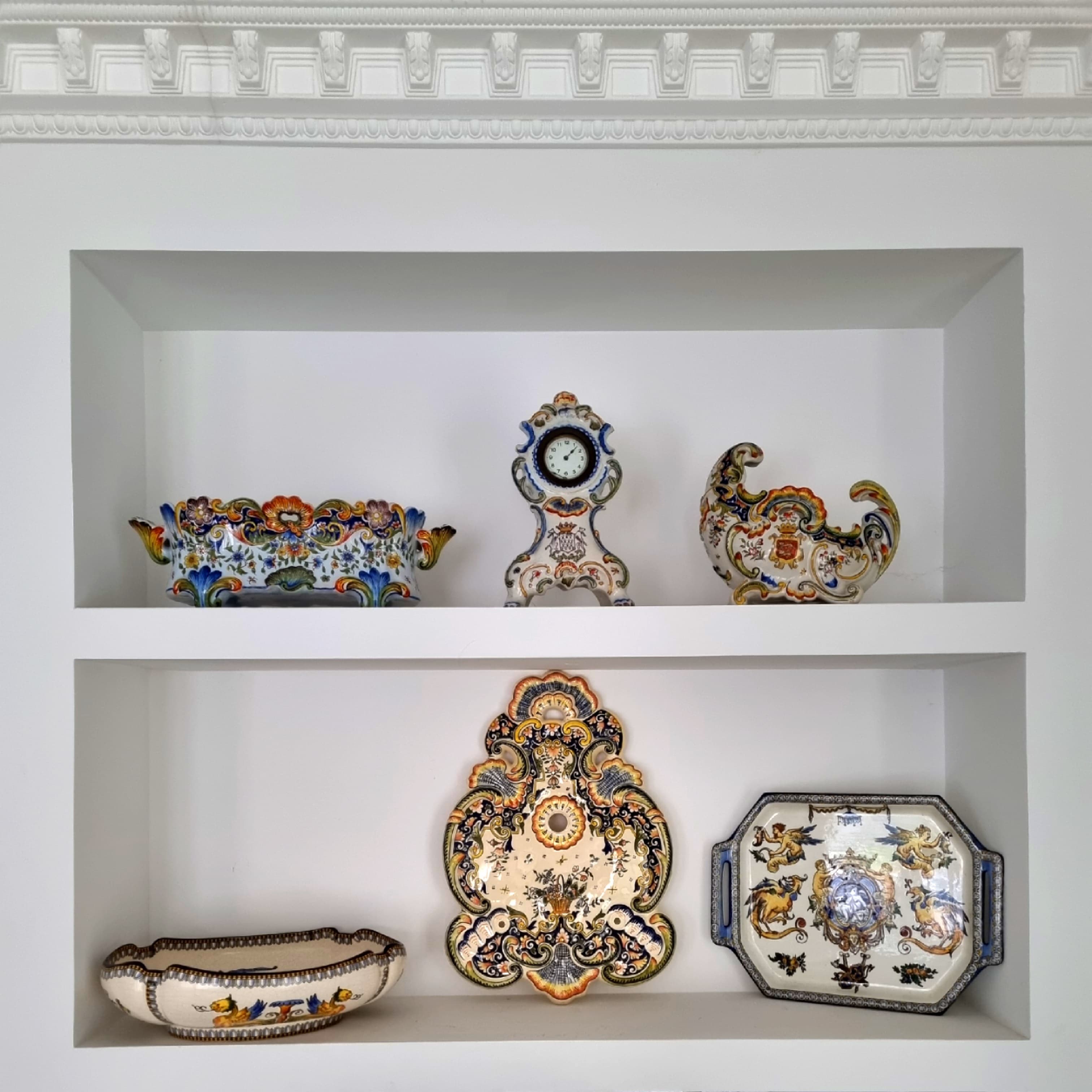
You are standing in a tent at Round Top. A dealer has a whole shelf of blue and white French pottery. Some pieces are $35. Some are $350. You want to buy something, but you want to buy something good. Here is what to actually check before you hand over a credit card.
Pick It Up
The first thing to do with any piece of faience is lift it. Real earthenware is heavy. Much heavier than porcelain, noticeably heavier than modern pottery of the same size. Earthenware is fired at a lower temperature, so the clay body stays denser and thicker. If a plate feels surprisingly substantial in your hand, that is a good sign.
Earthenware is also durable in a specific way. Dr. Lori, a well-known ceramics appraiser, puts it like this: if you drop a piece of earthenware, it will probably crack, but it usually will not chip cleanly the way porcelain does. This is why so many old faience pieces survive with hairline cracks rather than missing chunks.
Look at the Glaze
Hold the piece up to the light and study the white glaze. Real tin glaze is opaque, slightly uneven, and has a soft warmth to it. It is not bright chalky white and it is not glassy-slick like modern ceramic. It has what collectors sometimes call a fat surface, a slight thickness that catches light in an imperfect way.
Check for these things:
- Crazing: the fine spiderweb of hairline cracks across the glaze surface. Very common on old faience. Not a dealbreaker. Often adds character.
- Chips on the rim: very common, because earthenware rims are exposed. Small chips are acceptable on display pieces but they do reduce value.
- Glaze pooling: where the glaze ran thick in a corner or a low spot. Hand-applied glaze does this. It is a sign of real handwork, not a flaw.
- Paint halos: the soft, slightly blurred edges around every brushstroke where the oxide paint sank into the wet glaze before firing. This is what makes faience look like faience.
Turn It Over
The base tells you more than the front. Look at the unglazed foot ring, the rough circle of exposed clay at the bottom. This is your best window into the actual clay body.
French faience clay ranges from gray to reddish-tan depending on where it was dug. A pale gray foot often points to northern France. A warm terracotta tone suggests southern workshops. The foot should feel slightly rough and worn, not sharp and fresh. If the foot looks brand new, you may be holding a reproduction.
Then check for marks. Very few early French faience pieces are signed at all. This is a real challenge for collectors and it is why provenance matters so much. Quimper pieces are the most commonly marked, with HB Quimper, Henriot Quimper, or simply Quimper France. Better-documented pieces, the ones with clear marks and known history, are significantly more valuable than unmarked pieces even when the unmarked piece is actually older.
The McKinley Tariff Rule
This is the single most useful dating trick you can learn. The McKinley Tariff Act of 1891 required that any item imported into the United States be marked with its country of origin in English.
- Base marked France: the piece was made for export to the US, 1891 or later
- Base marked Made in France: 20th century, usually post-1920
- No country of origin marking: could be pre-1891, or could be made for the European market, or could be unmarked earlier
The Color Palette Tell
The colors on a piece tell you roughly when it was made.
- Grand feu palette (cobalt blue, manganese purple, antimony yellow, copper green, iron red): the early high-fire technique, limited to five pigments. A piece decorated only in these colors is probably 18th century or earlier in style.
- Petit feu palette (all of the above plus pink and gold): a mid-18th century innovation. Pink and gold absolutely cannot appear on a piece made before this. If you see pink or gold, you are looking at mid-1700s or later.
Display Piece or Everyday Piece?
Not every antique plate needs to be museum condition. The question to ask yourself at the booth is: what am I going to do with this?
For display: pieces with minor glaze wear, some crazing, a small rim chip, soft paint fade. These are fine and often priced accordingly. A slightly worn Quimper plate on a wall looks just as good as a perfect one and costs half as much.
For daily use: look for pieces in very good condition with no cracks going through the body, solid foot, clean glaze. Terre de fer (French ironstone) is a good alternative here. It is the same heavy earthenware family and meant for everyday use. Our ironstone guide covers it in more depth.
For serious collecting: signed pieces from documented workshops, clean condition, grand feu palette if you can find it. These pieces live in display cabinets and come out on special occasions.
What to Actually Pay
Here is a realistic price range for French pottery at Round Top:
- Simple Quimper plates, 20th century, minor wear: $30 to $80
- Better Quimper pieces, pre-1940, good condition: $80 to $200
- 19th century faience plates, unattributed, charming decoration: $75 to $250
- Attributed 19th century pieces (Rouen-style, Moustiers-style) in good condition: $200 to $500
- Early 18th century faience in excellent condition (rare at Round Top): $500 and way up
Truly rare pieces, authenticated early Rouen or Moustiers in excellent condition, can go into the thousands at auction. You are not likely to find those at a field show, but you will find plenty of middle-ground pieces, charming and usable, in the $50 to $300 range. That is the sweet spot for most shoppers.
Next Post: How to Decorate With It
One more thing worth knowing before you shop: Round Top divides into two fundamentally different experiences — curated venues where dealers have done the editing, and open hunt fields where the prices are lower and the finding is the fun. The Show or The Hunt will help you decide which venues to prioritize for this category.
Now that you know what to buy and what to pay, the last post in the series is about what to do with a piece once it is home. The wall of plates, the chopping board vignette, the French kitchen approach to displaying everyday objects. In the meantime, pull up the Round Top Finder map and plan which tents to hit on your next trip.
Never Miss a Show
Get show dates, insider guides, and featured vendors delivered to your inbox. Monthly, never spammy.
Not ready to subscribe? Grab the free printable cheat sheet — no email required.