What to Look for When Buying Ironstone: A Collector's Checklist
You've spotted a pitcher on a dealer's table at Round Top. It's the right shape, the right color, and the price tag isn't scary. Now what?
This is the part that separates a great buy from a regret you'll stare at every morning when you pour the coffee. Here's exactly what to examine before you hand over the cash.
Step One, Look at the Color
Real ironstone is not stark white. It's a blue-gray white, warm and slightly off, with an almost-ivory softness. If a piece looks bright white like modern dinnerware, that's your first red flag. Hold it next to another piece on the table or next to a piece of paper. The difference jumps out immediately.
Age gives ironstone its particular color. Modern pieces and reproductions can't quite fake it.
Step Two, Check the Glaze
The glaze is where the magic is. Tilt the piece toward the light and look for a liquid, iridescent, pearlescent quality. Old ironstone almost glows. Collector Rajiv Surendra, who has spoken beautifully about ironstone, describes it as looking liquid.
If the glaze looks flat, matte, or uniformly bright, be suspicious. A good piece should feel a little alive in your hands.
Step Three, Run Your Fingers Around the Rim
You're checking for chips. Start at the rim and work your way around every edge, every handle, every foot. Chips on an ironstone piece are hard to hide even when dealers try. Run a fingernail over anything that looks suspicious.
Also look for hairline cracks. These often show as a fine dark line on the glaze or, on the inside of a pitcher, as a faint shadow running down from the rim. Cracks are a hard pass. A cracked piece will eventually fail, and if you're planning to use your ironstone (which you should), that's a problem.
Chips and cracks are both dealbreakers unless the price reflects it honestly.
Step Four, Decide How You Feel About Crazing
Crazing is the web of fine cracks you sometimes see in the glaze. It happens over decades as the clay body and the glaze expand and contract at different rates. On its own, crazing is mostly cosmetic.
The issue is that once the glaze is cracked, food and liquid can seep into the clay underneath. Over the years this stains the piece brown or amber, especially on the inside of bowls and pitchers.
Some collectors love the stained, aged look. Others want their ironstone clean and white. Neither is wrong. Just know which camp you're in before you buy, because crazing and staining are almost impossible to fully reverse.
Step Five, Flip It Over and Read the Mark
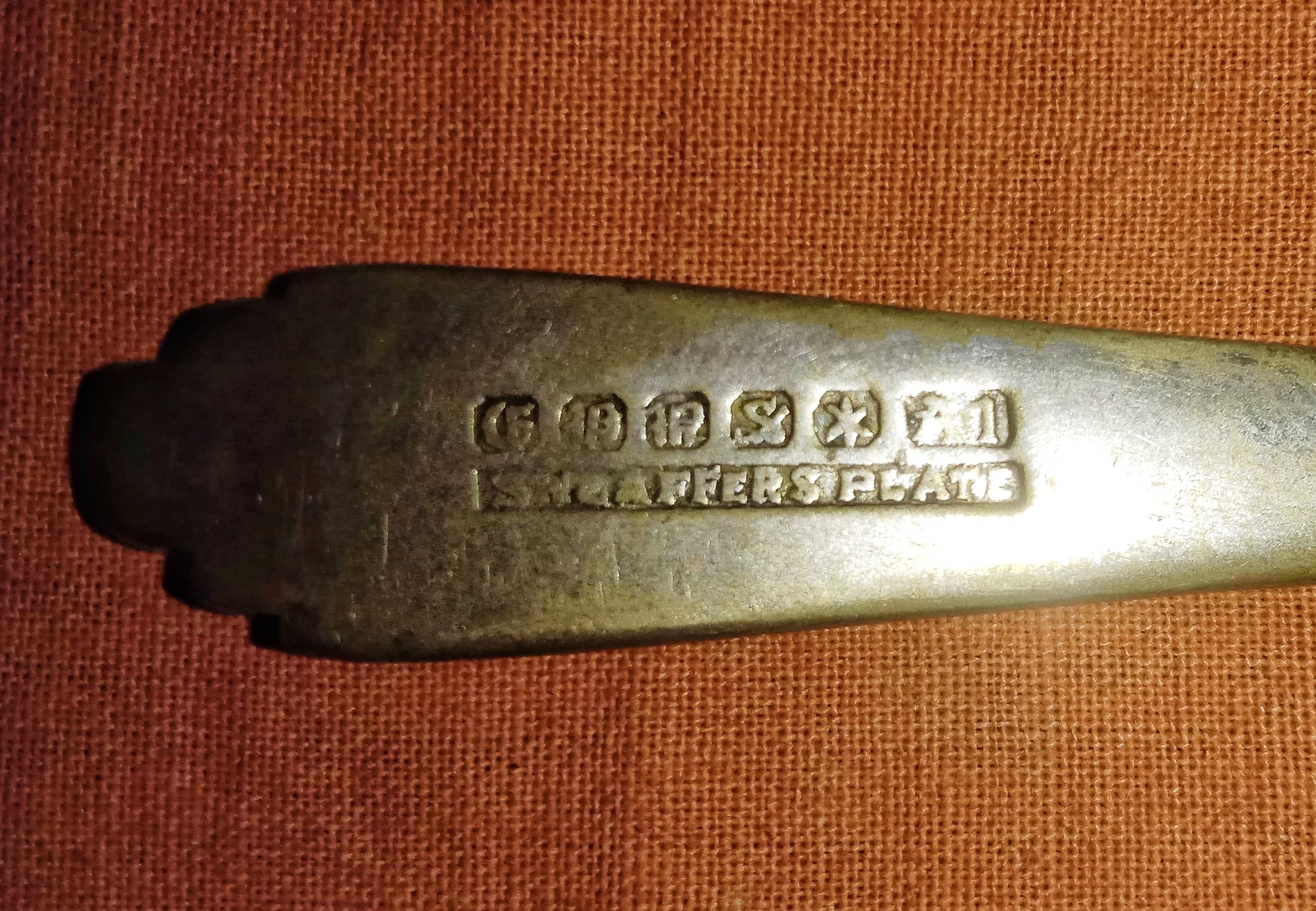
The bottom of the piece is where the story gets told. Most ironstone is stamped. Here's what the stamp can tell you.
- Clay-impressed marks. The oldest, most desirable pieces have marks that were pressed directly into the wet clay before firing. You can feel the indentation with your thumb. These are early 1800s pieces and they tend to be worth more.
- Transfer-printed marks. More common. These are printed onto the piece like a logo. Still legitimate, just typically later.
- The word "England." If the mark says England, the piece was made after 1910 or 1915. Before that, British law required only the maker's name. Most manufacturers adopted "England" fully by the early 1900s for pieces exported to the US.
- Rd marks. A diamond or a number preceded by "Rd" means the design was registered in Britain. These can help date a piece very precisely.
- Maker names to know. J&G Meakin Ironstone China. Johnson Brothers. Mason's. Three of the most common you'll run into at Round Top. All legitimate, all collectible.
Step Six, Watch for Marriages
A "marriage" in the antique world is when a lid from one piece gets paired with a base from another. The dealer bought them separately and combined them, usually because one came without a lid and the other without a base.
Marriages aren't fraud as long as the dealer is honest about it. But you should notice. The lid might be a slightly different color, a slightly different pattern, or not quite fit right. If the piece has a lid, try seating it. Does it wobble? Is the color a touch off? Ask the dealer directly. If it's a marriage, the piece should be priced as a marriage, not as a complete original.
Step Seven, Think About Price
Here's the strategy that separates smart buyers from impulse buyers. Only buy when a piece is underpriced relative to what you'd pay elsewhere.
The price range for the same ironstone piece can be wild. A covered dish that sells for $10 at a thrift store might run $150 to $200 at an established antique dealer. At Round Top, you'll see the full spread. A great piece at a Warrenton field can be half what a similar piece costs in a climate-controlled Marburger tent.
That doesn't mean the dealer at Marburger is ripping you off. It means the market has room. If a piece feels expensive to you, walk away. Another one will turn up.
Cleaning Tip, For After You Buy
If you end up with a piece that has light staining, here's a trick collectors use. Soak the piece in a sealed container with a mix of hydrogen peroxide and water. Leave it for two or three days. Light staining often lifts right out.
Do not use bleach. Bleach is bad for the clay body and can do long-term damage. Hydrogen peroxide is gentle and effective.
Bringing It Together
Ironstone shopping rewards patience. Walk the booths, pick up the pieces, feel the weight, tilt them in the light, flip them over, and read the marks. You'll develop an eye fast, and once you do, the whole process becomes a kind of treasure hunt.
Coming up next in the series: how to spot the Chinese reproductions that have flooded the market in the last 20 years and are easy to mistake for the real thing. If you're planning a trip, check out our First Timer's Guide and venue map to plan your route along Highway 237.
Never Miss a Show
Get show dates, insider guides, and featured vendors delivered to your inbox. Monthly, never spammy.
Not ready to subscribe? Grab the free printable cheat sheet — no email required.