Market Hill Round Top: Fall 2026 (Oct 12–Nov 1) Hours & Guide
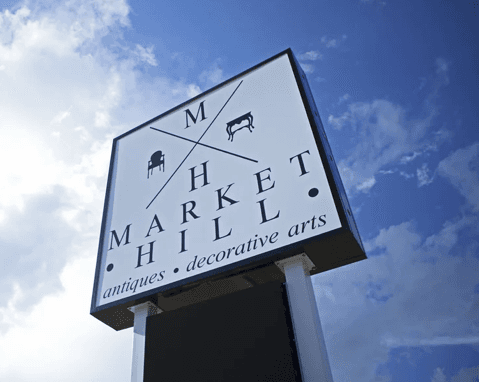
Market Hill Fall 2026: Dates, Hours & What's Happening
Market Hill's fall show runs Oct 12–Nov 1. It has 30+ antiques and artisan dealers across two permanent air-conditioned buildings, plus bars and the Duo Modern restaurant.
- Dates: Oct 12–Nov 1 · Hours: 9 AM–6 PM daily
- Address: 1542 Texas 237, Round Top, TX
On the calendar this fall:
- Mezcal & Art Reception at Architects Daughter (Oct 18, 4 PM–6 PM)
- Market Hill 10th Birthday Celebration (Oct 22, 4 PM–5 PM)
- Market Hill 10th Birthday Vendor Crawl (Oct 22, 11 AM–3 PM)
- Jeffrey Dungan Book Signing (Oct 27, 6 PM–8 PM)
- William Peace Under the Western Skies Book Signing (Oct 27, 4 PM–6 PM)
- Benjamin Reynaert Book Signing (Oct 28, 5 PM–7 PM)
See Market Hill on the Field Map · Full venue schedule · All fall events, day by day
Market Hill is the most expensive, most curated venue at the Round Top Antique Show — and it does not charge a dime to walk in. Housed in huge metal buildings along the highway between Round Top and Warrenton, it is where interior designers shop for clients, where European dealers display museum-quality pieces, and where first-timers quietly realize that a single nightstand can cost more than their car payment. If you want to see the absolute pinnacle of what Round Top has to offer, this is where you go.
But Market Hill is not just for deep pockets. It is also one of the best venues at Round Top for pure inspiration, for learning about antiques, and — if you know where to look — for finding a handful of vendors with prices that actually make sense. This guide breaks down everything: what to expect, who sells there, what things cost, and how to get the most out of your visit whether you are spending $50 or $50,000.
What Makes Market Hill Different from Every Other Venue
Round Top has dozens of venues, and they range from open-air fields where you dig through bins in the Texas heat to air-conditioned barns with carefully lit displays. Market Hill sits at the very top of that spectrum.
As one shopper put it after visiting for the first time: "Market Hill is like the most high-end it gets." That is not an exaggeration. The venue has expanded in recent years, adding more European-style metal buildings and attracting an increasingly international roster of dealers. One European antiques dealer who has attended fairs across the continent said Market Hill reminded him of "the antique fair in Parma, Italy" — high praise from someone who has seen the best that Europe offers.
What sets Market Hill apart is not just the price tags. It is the presentation. Every booth is merchandised with the kind of care you would expect from a showroom in the Design District. One designer who spent three days at Round Top described it this way: "It was merchandised so beautifully that there's so much inspiration there." Another added: "I loved shopping Market Hill because there was a little bit more space. You could see everything. There was enough room to move around."
That last point matters more than you might think. At many Round Top venues, you are elbow-to-elbow with other shoppers, squeezing between stacked furniture and overflowing bins. Market Hill gives you breathing room. The wide aisles and thoughtful layouts let you actually study the pieces — the patina on a 17th-century console, the hand-cut dovetails on a French commode, the original hardware on an 18th-century armoire.
Use the Round Top Finder map to see Market Hill's exact location relative to other venues before you plan your route.
Location and Logistics
Market Hill sits along Highway 237, the main corridor that connects Round Top's many venues. It is near The Halles, a popular venue known for its rugs and textiles, and a short drive from Cisco's and the XS fields.
Here is what you need to know before you arrive:
Admission: Free. No ticket required, no wristband, no early-buyer fee. Just walk in.
Restrooms: Real ones. Not porta-potties. This is a genuine luxury at Round Top, and Market Hill shoppers appreciate it more than you might expect after a long day in the fields.
Food: Available on site. You can eat without leaving the venue, which makes it easy to spend a full morning or afternoon here without losing your parking spot.
Parking: Generally manageable. Market Hill does not draw the same crush of early-morning stampede shoppers that Marburger Farm or Blue Hills might on opening day. The crowd here tends to be more deliberate — designers with specific lists, dealers scouting for inventory, collectors who know exactly what they want.
When to go: Market Hill is worth visiting at any point during the show, but mid-week tends to be quieter. If you want to negotiate, the final days of the show are your best bet — dealers would rather cut a deal than pack a 400-pound armoire back onto a truck.
The Vendors You Need to Know
Market Hill is home to some of the most respected dealers in the Round Top circuit. Here are the standouts.
Renovo Fine European Antiques
If you appreciate religious art and ecclesiastical antiques, Renovo is a destination. One dealer who has spent decades in the European antiques trade said flatly: "I've never seen a better collection of legitimate 18th-century European religious stuff than this particular dealer."
Renovo specializes in 17th- and 18th-century European pieces — gilt wood mirrors, religious paintings, carved consoles, and devotional objects that carry genuine age and provenance. Walking into their space at Market Hill is like stepping into a centuries-old European cathedral that happens to have price tags. Expect to see pieces dating back to the 1600s and 1700s, with prices that reflect their rarity and condition.
During one visit, a pair of antique dealers examined a baroque Italian mirror with silvering so old it had completely worn away from the glass — priced at $2,950. An early 19th-century French table was marked at $5,000. A gilt wood mirror with centuries of patina drew comparisons to pieces in European museum collections.
Paul Michael Company — The Holiday House Tent
Paul Michael Company operates one of the more unexpected spaces at Market Hill: the Holiday House tent, which is dedicated entirely to Christmas and holiday items. We are talking ornaments, decorations, themed tablescapes, and seasonal decor at a level of quality and price that most people have never encountered.
Shoppers who visited described it as "hands down the most expensive stuff we saw all weekend." This is not your neighborhood craft store. These are high-end, designer-quality holiday pieces priced for clients who want their homes to look like the cover of Veranda in December. If you are a designer sourcing holiday decor for a client's home, or if you simply want to see what Christmas looks like when money is no object, the Holiday House tent is a singular experience at Round Top.
Nomadic Trading
Nomadic Trading is a family-owned rug business that also operates a booth at Excess 2. At Market Hill, they bring a curated selection of their inventory — vintage and antique rugs from Turkey, Europe, and beyond. The family travels internationally to source their pieces, and the quality shows. If you spot a rug you love at Excess 2, check their Market Hill booth as well — they sometimes split their inventory between the two locations.
Antiques Anarchy
Here is the insider tip that could save your Market Hill visit if you are on a budget. Antiques Anarchy, a dealer from Chicago, is consistently cited as the most affordable option within Market Hill. One designer called out their "really nice pieces for very reasonable prices," which is about the highest compliment you can give a vendor at the show's most expensive venue.
They carry Swedish sofas, mid-century pieces, and a range of European furniture that holds its own alongside the higher-priced dealers in neighboring booths. If you want the Market Hill experience without the Market Hill sticker shock, start here. Note that they may not always have prominent signage — ask around if you do not spot them immediately.
Amelia Tarbey
Amelia Tarbey specializes in pieces from the 1970s and 1980s — a distinct niche within Market Hill's predominantly 17th-to-19th-century landscape. Her inventory leans toward an acquired taste, with bold shapes and period-specific design that appeals to collectors and designers looking for something outside the European antiques mainstream.
Other Notable Dealers
Several other vendors round out the Market Hill experience:
- The Architect's Daughter — Architectural pieces and curated antiques
- Mave — A well-regarded dealer with a strong following among designers
- Provenance Antiques — European pieces with documented histories
- Susan Horn — Beautiful setups and curated vignettes; a favorite for coffee table books and styled accessories
You can find more details on each of these vendors, including photos and booth information, on the Round Top Finder vendor directory.
What Things Actually Cost at Market Hill
Let's talk numbers, because Market Hill's reputation for being expensive is well-earned — but the range is wider than most people assume.
Here is a sampling of real prices spotted at Market Hill across recent shows:
| Item | Price |
|---|---|
| Spiral staircase | $8,900 |
| Pair of nightstands | $14,000 |
| Small antique chests | $10,000 |
| Early 19th-century French table | $5,000 |
| Baroque Italian mirror | $2,950 |
| Dining table (described as "a steal") | $2,000 |
| Cast iron and marble side table | $995 |
| Paris coffee table book | $40-75 |
One husband who accompanied his designer wife through Market Hill offered perhaps the best pricing heuristic anyone has ever coined: "If it smells good and feels good, it's expensive." He is not wrong. The booths with the most beautiful displays, the best lighting, and the most intoxicating ambiance are invariably the ones with the highest price tags.
But that $2,000 table? Multiple shoppers flagged it as a genuine steal — a price you would expect to see at the field venues, not at Market Hill. Deals do exist here. They are just harder to find, and they require knowing what things are actually worth.
The Markup Controversy: Field to Market Hill
No honest guide to Market Hill can skip this topic. There is a well-known dynamic at Round Top that experienced shoppers talk about openly: some Market Hill dealers shop at the field venues — particularly Excess I and Excess 2 — buy pieces at field prices, and resell them at Market Hill with significant markups.
As one shopper described it: "People from Market Hill will shop at Excess I and Excess 2 for their pieces and then bring them to their shops and resell them."
How much of a markup? Estimates from experienced Round Top shoppers suggest pieces can be marked up two to three times their field price once they land in a Market Hill booth.
Is this a reason to avoid Market Hill? Not necessarily. The markup reflects real value-adds: the dealer's expertise in identifying quality pieces, the curation and merchandising that makes the shopping experience pleasant, the convenience of finding everything in one place rather than digging through a muddy field at 7 a.m., and the assurance that what you are buying has been vetted by a professional eye.
But if you are budget-conscious and willing to put in the work, shopping the fields first — particularly in the early days of the show — can net you pieces that would cost significantly more at Market Hill. Check the Round Top Finder venue pages to plan a strategic route that hits the field venues before Market Hill.
Who Should Shop Market Hill
Interior designers shopping for clients. This is Market Hill's core audience. The pieces here are the kind that anchor a room — a statement mirror over a fireplace, a 200-year-old dining table, a pair of antique sconces that set the tone for an entire hallway. If you are billing a client and need pieces with genuine provenance and visual impact, Market Hill delivers.
Collectors of European antiques. If your interest is specifically in 17th-, 18th-, and 19th-century European pieces — French, Italian, Swedish, English — Market Hill has one of the strongest concentrations at Round Top. The quality of the religious art, gilt wood, silver, and furniture here is genuinely world-class.
Anyone who wants inspiration. Even if you cannot afford a single thing at Market Hill, it is worth an hour of your time. The way these dealers merchandise their booths is a masterclass in interior design. Pay attention to how they group objects, how they mix periods, how they use scale and color. Take photos. Screenshot things for your mood board. The inspiration alone is worth the trip.
First-timers who want to understand quality. If you are new to antiques and want to train your eye, Market Hill is the place to start. Spend time here looking at how genuine 18th-century dovetails differ from modern reproductions. Study the patina on original hardware. Ask the dealers questions — most of them are passionate about their pieces and happy to educate a curious shopper.
How to Shop Market Hill Like a Pro
Start at Antiques Anarchy if you want to buy. Get your affordable wins early, then browse the higher-end booths with less pressure on your wallet.
Bring measurements. If you are shopping for a specific space, know your dimensions. That stunning 19th-century French credenza will not help you if it is six inches too wide for your dining room wall.
Carry cash or checks. Many Market Hill dealers offer better prices for cash transactions, and some add a 3% surcharge for credit cards. On a $5,000 table, that is $150 you could save.
Ask about provenance. The dealers at Market Hill generally know the history of their pieces. A documented provenance adds value and interest — and it is the kind of detail that matters when you are investing at this level.
Compare before you commit. If you see something you love, note the dealer name and price in the Round Top Finder app, then check Excess I, Excess 2, and the field venues for similar pieces at lower prices. You may find the same style at a fraction of the cost — or you may confirm that the Market Hill piece is worth every penny.
Visit Market Hill and The Halles together. They are across the street from each other, so you can easily combine them into a single stop. The Halles is known for its rugs and textiles, which complement the furniture and art you will find at Market Hill.
Frequently Asked Questions
How much does it cost to get into Market Hill?
Nothing. Admission to Market Hill is completely free, which makes it one of the most accessible high-end experiences at Round Top. Unlike Marburger Farm, which charges an admission fee, you can walk into Market Hill without spending a cent.
Is Market Hill worth visiting if I am on a tight budget?
Yes, but manage your expectations. You are unlikely to find many pieces under $500, with the notable exception of Antiques Anarchy and a few smaller accessories at vendors like Susan Horn. That said, the inspiration value is enormous. Designers consistently say that even when they cannot buy at Market Hill, the merchandising and curation give them ideas they use in their own work for months afterward.
What are Market Hill's hours during the show?
Market Hill is open during standard show hours, which vary by season. Unlike some venues, it does not have a hard 6 p.m. cutoff — some dealers stay open a bit later. Check the Round Top Finder venue page for Market Hill for current hours and opening dates.
How does Market Hill compare to Marburger Farm?
Both are high-end, but they have different personalities. Marburger Farm is massive — five football-field-sized tents plus historic buildings — with a wider range of price points, especially in the tent sections where traveling vendors are more negotiable. Market Hill is smaller, more focused, and skews more consistently toward the top of the price spectrum. Marburger charges admission; Market Hill does not. If you can only visit one, Marburger offers more variety. If you want the most curated, highest-end experience, Market Hill is the answer.
What types of antiques are most common at Market Hill?
European antiques dominate: French, Italian, Swedish, and English pieces from the 17th through 19th centuries. You will find furniture (tables, consoles, armoires, chests, nightstands), decorative objects (gilt wood mirrors, silver, chandeliers, sconces), art (portraits, religious paintings, oil paintings), architectural salvage (spiral staircases, carved columns), and specialty items like Staffordshire dogs, oyster plates, and antique books. Paul Michael Company's Holiday House tent adds a seasonal dimension with high-end Christmas decor.
Can I negotiate prices at Market Hill?
You can always ask, but expect less flexibility than at the field venues. Market Hill dealers price their pieces with expertise and generally have firm ideas about what their inventory is worth. That said, buying multiple pieces from the same dealer, paying in cash, and shopping on the final days of the show all improve your chances of getting a better price.
Where should I park for Market Hill?
Market Hill has its own parking area along Highway 237. Arriving mid-morning on a weekday is your best bet for easy parking. On weekends and opening days, arrive early or be prepared to walk a bit.
Is Market Hill open year-round or only during the show?
Market Hill is primarily a show venue, operating during the spring, fall, and winter Round Top Antique Show seasons. Some individual dealers may have year-round operations elsewhere. Check the Round Top Finder calendar for exact show dates.
The Bottom Line
Market Hill is not for everyone, and it does not pretend to be. It is the venue where Round Top reaches its highest expression — where centuries-old European antiques are displayed with the same care you would find in a Paris gallery, where a single piece of furniture can cost more than some people spend on an entire room, and where the line between shopping and art appreciation blurs completely.
But it is also free to enter, easy to navigate, and home to at least one vendor (Antiques Anarchy) that proves you do not need a designer's budget to find something worth taking home. Whether you go to buy, to browse, or simply to understand what the very best of Round Top looks like, Market Hill belongs on your itinerary.
Plan your Market Hill visit with Round Top Finder — search vendors, check the interactive map, and build your show-day route so you do not miss a thing.
More Round Top Guides
Venue Deep Dives: Big Red Barn | Blue Hills | The Compound | Excess 1 & 2 | The Halles | Horseshoe | Bader Ranch | Bar W Field
Planning Your Trip:
- The Definitive Guide to Round Top 2026
- Trip Planner: 1, 2, or 3 Day Itineraries
- What to Bring
- Admission & Costs
Browse all venues on the interactive map or download the Round Top Finder app to plan your trip.
Full Guide
Round Top Antique Show
Complete guide to the world's largest antique fair — vendors, venues, dates, and tips.
Never Miss a Show
Get show dates, insider guides, and featured vendors delivered to your inbox. Monthly, never spammy.
Not ready to subscribe? Grab the free printable cheat sheet — no email required.